Car Loan Rates by Credit Score in Canada
January 21, 2026
Last updated: October 2026
Car loan rates by credit score in Canada generally become more competitive as your credit profile improves. Borrowers with stronger credit histories may qualify for lower interest rates, while those with fair, poor or limited credit may face higher borrowing costs.
However, there is no official Canadian interest-rate table that guarantees a particular APR based on your credit score. Lenders use different scoring models, assess affordability differently and consider the vehicle being financed before making an offer.
This guide explains how credit scores influence car loan rates in Canada, what different credit categories may mean for your financing options, and how changes in interest rates affect your monthly payments. You can also explore our car loan guides for more information about vehicle financing.
How Does Your Credit Score Affect Car Loan Interest Rates?
Your credit score helps lenders assess the likelihood that you will repay borrowed money as agreed.
A stronger credit profile may indicate a history of managing credit responsibly, making payments on time and maintaining manageable debt. This can make you eligible for more competitive financing offers.
A lower score may indicate previous missed payments, high outstanding balances, limited credit history or other factors that increase the lender’s perceived risk.
To account for that risk, some lenders may charge higher interest rates, offer shorter repayment terms or apply additional eligibility requirements.
However, your credit score is only one part of a car loan application. Lenders may also consider your income, existing debt, employment circumstances, down payment, vehicle age and total affordability.
Car Loan Rates by Credit Score in Canada: What to Expect
Canadian credit scores commonly range from 300 to 900. Although higher scores generally indicate lower credit risk, there is no universal scoring system used by every Canadian lender.
The following table shows commonly referenced Canadian credit-score categories and how they may influence car financing.
| Credit Score Range | Credit Category | What It May Mean for Car Financing |
|---|---|---|
| 760–900 | Excellent | Potential access to highly competitive rates, subject to lender and vehicle eligibility. |
| 725–759 | Very Good | Generally favourable financing options, although rates depend on the complete application. |
| 660–724 | Good | May qualify for competitive financing, with offers varying between lenders. |
| 560–659 | Fair | Financing may be available at higher interest rates or with additional conditions. |
| 300–559 | Poor | Approval may be more challenging, and available financing can involve substantially higher borrowing costs. |
Source: Equifax Canada educational infographic. These are illustrative credit-score categories, not lender-specific thresholds or guaranteed car loan rates. Credit bureaus and lenders may use different scoring models and classifications.
Important: These score categories do not represent guaranteed approval thresholds or official car loan APR ranges. Two borrowers in the same category may receive very different financing offers.
For a national lending benchmark, see our guide to the average car loan interest rate in Canada.
What Credit Score Do You Need for a Car Loan in Canada?
There is no single minimum credit score required for every car loan in Canada.
Each lender establishes its own approval criteria. Some financial institutions may prefer applicants with established credit histories, while specialized lenders may consider applications from borrowers with lower scores or previous credit difficulties.
A credit score of 660 or above falls within the good or higher categories in the commonly referenced table above. However, that does not guarantee approval or a particular interest rate.
Similarly, having a score below 660 does not automatically mean your application will be declined.
Lenders may consider:
- Income: Whether your earnings are sufficient to support the proposed payments.
- Existing debt: How much of your income is already committed to other repayments.
- Employment circumstances: The stability and consistency of your income.
- Down payment: How much you can contribute towards the vehicle purchase.
- Vehicle details: The age, mileage, condition and value of the vehicle.
- Credit history: Your repayment behaviour, recent enquiries and any serious negative credit events.
The most useful question is not simply whether your score meets a particular threshold, but whether a lender considers the overall loan affordable and appropriate for your circumstances.
How Much Does Your Credit Score Affect Your Car Loan Payments?
Credit scores influence the financing offers available to borrowers, but the interest rate you actually receive determines how much interest you pay.
Consider a borrower financing $30,000 over 60 months at different fixed annual interest rates.
| Annual Interest Rate | Approx. Monthly Payment | Approx. Total Interest |
|---|---|---|
| 5% | $566 | $3,968 |
| 7% | $594 | $5,642 |
| 10% | $637 | $8,245 |
| 15% | $714 | $12,822 |
| 20% | $795 | $17,689 |
Example assumptions: $30,000 financed over 60 months at a fixed annual interest rate, with monthly compounding and equal monthly payments. Figures are illustrative and rounded. Taxes, fees, optional products and other charges are excluded. These rates are not assigned to particular credit-score categories.
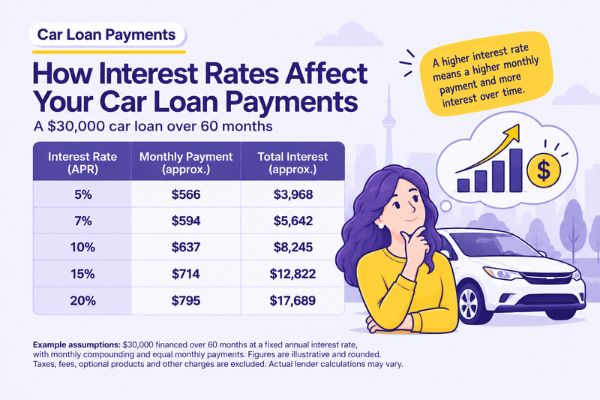
At 5% interest, the borrower would pay approximately $3,968 in interest over five years. At 15%, the total interest would increase to approximately $12,822.
That is a difference of around $8,854 in interest on the same loan amount and repayment term.
This illustrates why improving your credit profile and comparing financing offers can be valuable before purchasing a vehicle.
Use our car loan calculator to explore how different rates, loan amounts and repayment periods affect your estimated payments.
Excellent and Very Good Credit Car Loan Rates
Borrowers with excellent or very good credit profiles may have access to a wider selection of competitive vehicle-financing options.
A strong credit history can indicate consistent repayment behaviour and responsible management of existing credit obligations.
However, even applicants with excellent credit are not guaranteed the lowest advertised rate.
Financing offers may still depend on:
- Whether the vehicle is new or used.
- The age and mileage of the vehicle.
- The amount being financed.
- The size of the down payment.
- The repayment term.
- The lender’s current products and eligibility requirements.
For example, a borrower with excellent credit financing an older used vehicle may receive a different offer from someone purchasing a new vehicle with manufacturer-supported promotional financing.
Compare the complete financing terms rather than assuming your credit score automatically qualifies you for the lowest available interest rate.
Good Credit Car Loan Rates
Borrowers with good credit may qualify for competitive car financing, although their options can differ from those available to applicants with stronger credit profiles.
Lenders may consider the applicant’s wider credit history, income and existing financial commitments when deciding what rate to offer.
Two borrowers with similar credit scores may therefore receive different interest rates because one has a higher debt burden, a smaller down payment or a different vehicle.
If you have good credit, it may be worth comparing financing offers from banks, dealerships and other eligible lenders before committing to an agreement.
Even a modest difference in interest rate can affect the total amount you repay over several years.
Fair Credit Car Loan Rates
Borrowers with fair credit may still qualify for vehicle financing, but the interest rates and repayment conditions available to them can be less favourable.
A fair credit score does not necessarily mean you have a history of serious financial difficulties. Your score may be affected by factors such as high credit utilization, a relatively short credit history or occasional missed payments.
Lenders may place greater emphasis on affordability, income consistency and vehicle selection when reviewing applications from borrowers in this category.
Before applying, consider:
- Checking your credit report for errors.
- Reducing outstanding debt where possible.
- Saving a larger down payment.
- Choosing a vehicle that fits comfortably within your budget.
- Comparing the total borrowing cost across available offers.
You may also want to explore car loan pre-approval in Canada to understand the potential benefits and limitations of obtaining a financing assessment before choosing a vehicle.
Bad Credit Car Loan Rates in Canada
Having poor credit can make car financing more challenging, but it does not automatically rule out every option.
Some specialized auto lenders consider applicants with previous missed payments, collections, limited credit histories or other credit difficulties.
However, these financing arrangements may involve higher interest rates, additional conditions or restrictions on the vehicles that can be financed.
Approval is never guaranteed. Lenders still need to assess the applicant’s ability to repay the loan and whether the proposed financing meets their requirements.
Should You Accept a High-Interest Car Loan?
Before accepting a high-interest offer, calculate how much the loan will cost over its full repayment period.
A manageable monthly payment does not necessarily mean the financing is affordable overall.
For example, extending a loan over a longer period may reduce the required monthly payment while increasing the total interest paid. It can also increase the risk of owing more than the vehicle is worth.
If the borrowing costs are too high, consider whether purchasing a less expensive vehicle, increasing your down payment or delaying the purchase could improve your financial position.
For more information about financing options and eligibility considerations, read our guide to bad credit car loans in Canada.
Can You Get a Car Loan With No Credit History?
Some Canadians have limited or no established credit history, even if they have never missed a payment.
This can affect newcomers to Canada, younger borrowers and people who have rarely used credit products.
Without an established repayment history, lenders may have less information available to assess how an applicant manages borrowed money.
However, a lack of credit history is not the same as having a history of missed payments or unpaid debts.
Lenders may place additional emphasis on:
- Employment and income stability.
- Existing financial commitments.
- The size of the down payment.
- The vehicle’s value and condition.
- Any alternative information the lender is willing to consider.
Some applicants may also consider applying with a co-signer where the lender permits this. However, co-signing creates a serious financial obligation for the other person, who may become responsible for repayment if the primary borrower does not pay.
For additional information, see our guide to car loans for newcomers to Canada.
What Else Do Lenders Consider Besides Your Credit Score?
Credit scores are useful indicators of credit risk, but lenders generally evaluate the complete application before deciding whether to offer financing.
1. Income and Affordability
Lenders may review your income and existing financial commitments to assess whether you can reasonably afford the proposed car loan payments.
A strong credit score does not guarantee approval if the repayment amount is considered unaffordable.
2. Existing Debt
Credit cards, personal loans, mortgages and other financial commitments can affect how much additional debt a lender considers manageable.
Reducing outstanding debt may improve your financial position and, in some circumstances, your financing options.
3. Down Payment
A larger down payment reduces the amount you need to borrow.
This can lower your monthly payment and total interest cost, even if the lender offers the same interest rate.
A larger down payment may also reduce the lender’s exposure relative to the vehicle’s value, although it does not guarantee a lower rate.
4. Vehicle Age and Value
The vehicle being financed can influence the loan terms available.
Some lenders have restrictions on vehicle age, mileage, condition or resale value. Older vehicles may qualify for different rates or shorter repayment periods.
Learn more in our comparison of new versus used car loan rates in Canada.
5. Loan Term
A longer repayment term generally reduces the monthly payment when the loan amount and interest rate remain unchanged.
However, it also increases the total interest paid over the life of the loan.
Some lenders may also charge different rates depending on the repayment term and vehicle.
Why Your Credit Score May Differ Between Equifax and TransUnion
Equifax and TransUnion are Canada’s two major credit bureaus.
Your credit scores may differ between them because the information reported to each bureau, the timing of updates and the scoring models used may not be identical.
In addition, a lender may use a different version of a credit score from the one you see through a consumer credit-monitoring service.
This means a score described as good by one service may not be interpreted in exactly the same way by every lender.
Rather than focusing on a single number, pay attention to the information contained in your credit reports, particularly payment history, outstanding balances and any inaccurate entries.
Does Applying for Multiple Car Loans Affect Your Credit Score?
When you formally apply for vehicle financing, a lender may conduct a hard credit enquiry.
Hard enquiries can affect your credit score, although the impact depends on the scoring model and your wider credit profile.
Some scoring models may group multiple enquiries for the same type of loan made within a defined shopping period, but the applicable timeframe and treatment can vary.
Before submitting applications, ask whether the lender will conduct a hard or soft credit check and whether your application may be shared with multiple financing providers.
Comparing offers remains important, but you should understand how the application process works before authorizing credit enquiries.
Interest Rate vs APR: What Should You Compare?
When comparing car loans, it is important to understand the difference between the interest rate and the annual percentage rate (APR).
The interest rate generally describes the rate charged on the outstanding loan balance.
The APR is an annualized measure of borrowing costs calculated according to applicable disclosure requirements. Depending on the agreement and relevant rules, it may account for certain financing charges in addition to interest.
Not every charge associated with purchasing or financing a vehicle is necessarily included in the APR.
For a meaningful comparison, review:
- The disclosed APR and interest rate.
- The total amount financed.
- The repayment period and payment frequency.
- The total cost of borrowing.
- Any financing fees or optional products.
- Early repayment conditions.
Read our guide to APR versus interest rate for car loans in Canada for a more detailed explanation.
How to Improve Your Chances of Getting a Lower Car Loan Rate
Improving your credit profile may help you qualify for more competitive financing, although results vary depending on the lender and your overall circumstances.
Check Your Credit Reports
Review your credit information for inaccurate personal details, unfamiliar accounts or incorrect payment records.
If you identify an error, contact the relevant credit bureau to request an investigation.
Make Payments on Time
Consistently paying credit obligations by their due dates can help establish a positive repayment history.
Credit improvement usually takes time, particularly if your report contains serious negative information.
Reduce Outstanding Debt
Reducing credit card balances and other outstanding obligations may improve your financial position and help demonstrate that you can manage additional repayments.
Save a Larger Down Payment
Borrowing less reduces the amount on which interest is calculated.
Even where the interest rate remains unchanged, a larger down payment can lower both the monthly payment and total borrowing cost.
Choose an Affordable Vehicle
A less expensive vehicle may allow you to borrow a smaller amount and maintain more room in your budget for insurance, fuel, maintenance and unexpected expenses.
Compare Multiple Financing Offers
Different lenders may assess the same borrower differently.
Compare offers using the same loan amount and repayment term wherever possible, and focus on the full borrowing cost rather than the monthly payment alone.
The Financial Consumer Agency of Canada recommends comparing financing terms and understanding the risks associated with longer car loans.
Can You Refinance a Car Loan After Improving Your Credit?
Some borrowers consider refinancing an existing car loan after their credit profile or financial circumstances improve.
Refinancing involves replacing an existing loan with a new financing agreement, potentially with a different lender, interest rate or repayment term.
A lower interest rate may reduce borrowing costs, but refinancing does not automatically result in savings.
Before refinancing, compare:
- Your current outstanding loan balance.
- The new interest rate and APR.
- Any fees or repayment charges.
- The remaining term of your existing loan.
- The proposed term of the new loan.
- The total amount you would repay under each option.
Extending the repayment period may reduce monthly payments while increasing the total interest paid.
Learn more about the process in our guide to car loan refinancing in Canada.
Frequently Asked Questions About Car Loan Rates by Credit Score in Canada
What credit score is needed for a car loan in Canada?
There is no universal minimum credit score for a car loan in Canada. Each lender sets its own eligibility requirements and may consider income, existing debt, vehicle details and affordability alongside credit history. A higher score may improve your options, but it does not guarantee approval.
What car loan rate can I get with a 700 credit score?
A 700 credit score falls within the good category in one commonly referenced Canadian scoring guide. However, there is no official APR assigned to a score of 700. Your actual rate depends on the lender, vehicle, loan amount, repayment term and wider financial circumstances.
Is a 650 credit score good enough for a car loan?
A 650 credit score may be sufficient for some lenders, but approval is not guaranteed. A score of 650 falls within the fair category in one commonly referenced Canadian scoring guide. Lenders will also assess your income, existing debts and the vehicle being financed.
Can I get a car loan with a 500 credit score in Canada?
Some specialized lenders may consider applications from borrowers with credit scores around 500. However, financing options may be limited, interest rates can be higher and approval depends on affordability and lender criteria. A lower score does not guarantee either approval or rejection.
Do people with excellent credit always get the lowest car loan rates?
No. Excellent credit may improve access to competitive financing, but the final interest rate also depends on the lender, vehicle, loan term, down payment and available promotions. A strong credit score does not guarantee the lowest advertised rate.
Can I get a car loan with no credit history?
Some lenders consider applicants with limited or no established credit history. They may place additional emphasis on income, employment, down payment and affordability. Approval and interest rates depend on the lender’s requirements.
Are used car loan rates higher for borrowers with bad credit?
Used vehicle financing can carry higher rates than new vehicle financing, and borrowers with weaker credit profiles may face additional borrowing costs. However, the actual rate depends on the lender, vehicle, applicant and financing arrangement.
Will checking my own credit score lower it?
Checking your own credit report or score generally does not lower your credit score. However, a formal loan application may involve a hard credit enquiry, which can affect your score depending on the scoring model.
Can I improve my car loan interest rate after approval?
You may be able to obtain a different interest rate by refinancing, subject to lender approval. However, fees, repayment conditions and a longer loan term can offset potential savings. Compare the total borrowing cost before refinancing.
Does a larger down payment help if I have bad credit?
A larger down payment reduces the amount you need to finance and may improve the affordability of the loan. It may also reduce the lender’s exposure, but it does not guarantee approval or a lower interest rate.
Final Thoughts: Finding a Competitive Car Loan Rate for Your Credit Profile
Your credit score can have a significant influence on the car loan rates available to you in Canada, but it does not determine your financing options on its own.
Borrowers with stronger credit profiles may qualify for more competitive offers, while those with fair, poor or limited credit histories may need to compare a wider range of financing options.
Regardless of your score, the most important considerations are whether the payments are affordable and how much the loan will cost over its full repayment period.
Start by using our car loan calculator to estimate repayments at different interest rates.
When you’re ready to explore available financing options, apply online with ZoomCarLoans. Available offers and approval depend on lender eligibility and assessment criteria.


The ZoomCarLoans Editorial Team brings you practical advice on car financing, credit building, and vehicle buying in Canada. Our goal is to make car loans easier to understand — and easier to get approved for.