APR vs Interest Rate for Car Loans in Canada
January 28, 2026
Last updated: October 2026
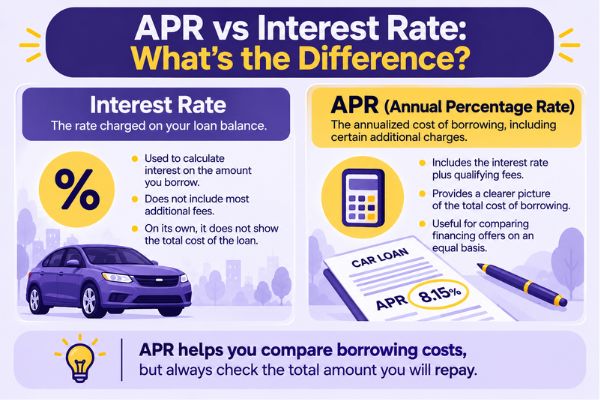
What is the difference between APR and interest rate on a car loan in Canada? The interest rate is the rate used to calculate interest on your outstanding loan balance. The annual percentage rate (APR) expresses the cost of borrowing as an annual percentage and can account for certain additional borrowing charges.
When a car loan has applicable non-interest borrowing costs, its APR may be higher than its stated interest rate. However, APR does not necessarily include every fee or optional product associated with buying a vehicle.
Understanding both figures can help you compare financing offers, identify additional costs and avoid choosing a loan solely because it advertises a low interest rate.
This guide explains how APR works in Canada, why it can differ from the interest rate, how repayment terms affect borrowing costs and what to check before signing a car financing agreement.
What Is an Interest Rate on a Car Loan?
A car loan’s interest rate is the rate used to calculate interest on the money you owe.
For a typical fixed-rate vehicle loan, interest is calculated according to the terms of the financing agreement, and regular payments reduce the outstanding balance over time.
For example, a loan with a stated annual interest rate of 7% uses that rate to calculate interest according to the contract’s interest calculation and payment schedule.
The interest rate is important because it influences your monthly payments and total interest charges.
However, the stated interest rate does not necessarily account for separate financing fees or other charges that may apply.
What Is APR on a Car Loan in Canada?
APR stands for annual percentage rate. It expresses the cost of borrowing as an annual percentage of the loan principal, calculated according to the applicable disclosure rules.
APR can include both interest and certain non-interest borrowing charges.
Depending on the loan and applicable regulations, these may include qualifying:
- Loan administration or processing charges.
- Broker fees associated with arranging the financing.
- Other charges classified as part of the cost of borrowing.
Not every fee is automatically included in APR. Some charges are excluded under applicable rules, and optional products may be treated differently from mandatory borrowing costs.
For this reason, APR is a useful standardized comparison measure, but it is not a substitute for reviewing the full financing agreement.
For loans covered by federal consumer protection legislation, the Financial Consumer Protection Framework Regulations contain rules on cost-of-borrowing disclosures and APR calculations. Other financing arrangements may be subject to provincial or territorial requirements.
APR vs Interest Rate: Key Differences
| Feature | Interest Rate | APR |
|---|---|---|
| What it measures | The rate used to calculate interest on the loan balance. | The annualized cost of borrowing under applicable disclosure rules. |
| Includes interest | Yes. | Yes. |
| Includes non-interest borrowing charges | Not in the stated interest rate. | Certain qualifying charges may be included. |
| Expressed as a percentage | Yes. | Yes. |
| Can the figures be identical? | Yes. | Yes, where the applicable calculation produces the same rate. |
| Shows total dollars repaid | No. | No. |
| Best use | Understanding the rate charged on the outstanding balance. | Comparing annualized borrowing costs between offers. |
Important: Neither percentage tells you the full dollar cost of the loan on its own. You also need the amount financed, repayment term, applicable charges and total payments.
Can APR Be Higher Than the Interest Rate?
Yes. APR may exceed the stated interest rate when additional charges are included in the cost-of-borrowing calculation.
Consider two hypothetical car loans with the same interest rate and repayment term.
| Loan Details | Loan A | Loan B |
|---|---|---|
| Principal borrowed | $20,000 | $20,000 |
| Stated annual interest rate | 7% | 7% |
| Repayment term | 60 months | 60 months |
| Additional borrowing charge | $0 | $500 |
| Approx. monthly loan payment before separate charges | $396.02 | $396.02 |
| Approx. interest over 60 months | $3,761 | $3,761 |
| Approx. interest plus additional borrowing charge | $3,761 | $4,261 |
Example assumptions: Both loans have a $20,000 principal, a fixed 7% annual interest rate, monthly compounding and 60 equal monthly payments. Loan B has an additional $500 charge paid separately at the start of the loan. The charge is assumed to be an applicable non-interest cost of borrowing for APR purposes. Figures are approximate and rounded. No other fees or charges are included.
Both loans have the same stated interest rate and regular loan payment.
However, Loan B costs approximately $500 more because of the additional charge.
Assuming the charge must be included under the applicable APR rules, Loan B would have a higher disclosed APR than Loan A.
The exact APR must be calculated using the applicable Canadian regulatory method. It should not be estimated simply by adding a fee percentage to the interest rate.
This example demonstrates why two financing offers with identical stated interest rates can have different borrowing costs.
Can APR Be the Same as the Interest Rate?
Yes.
For some car loans, the disclosed APR and stated annual interest rate may be identical.
For example, applicable rules may produce the same APR as the annual interest rate when there are no additional non-interest borrowing costs and the required interest calculation conditions are met.
An APR that matches the interest rate is therefore not automatically an error.
Similarly, a higher APR does not necessarily indicate improper charges. It may reflect costs that must be included in the calculation.
If the figures differ, ask the lender to explain which borrowing charges are reflected in the disclosed APR.
Which Car Financing Fees Are Included in APR?
There is no single rule stating that every fee connected with buying a car must be included in APR.
Canadian disclosure requirements distinguish between charges that form part of the cost of borrowing and charges that may be excluded.
The treatment can depend on the nature of the charge, whether it is required to obtain financing and which federal or provincial rules apply.
| Charge | What Borrowers Should Check |
|---|---|
| Interest | Included in the cost-of-borrowing calculation. |
| Loan administration fees | May be included depending on the fee and applicable rules. |
| Broker or financing arrangement fees | May form part of the cost of borrowing. |
| Vehicle registration and licensing | Check the itemized purchase agreement and applicable treatment. |
| Optional loan insurance | Ask whether it is optional, what it costs and whether it affects financing. |
| Optional extended warranty | Review its separate price and any effect on the amount financed. |
| Late-payment or default charges | Review separately; these are not necessarily included in the initial APR. |
Even when a charge is not included in APR, it may still increase the amount you pay for the vehicle or financing arrangement.
Ask for an itemized breakdown of the vehicle price, financing charges and optional products before signing.
Does a Lower APR Always Mean a Cheaper Car Loan?
Not necessarily.
When comparing otherwise similar loans with the same amount financed, repayment term and payment structure, a lower APR is generally a useful indicator of lower annualized borrowing costs.
However, two loans can have different principal amounts, repayment terms or payment schedules.
For example:
- A lower-APR loan over seven years may involve more total interest than a higher-APR loan repaid over three years.
- A more expensive vehicle may cost more overall even if its promotional financing rate is lower.
- A financing offer with a low APR may require giving up a cash rebate available with another purchase option.
For a complete comparison, review both the APR and the total amount payable.
How Does Loan Term Affect APR and Total Interest?
Loan term affects monthly payments and the amount of interest paid over time.
For the same principal and stated interest rate, extending the repayment period generally reduces monthly payments but increases total interest paid.
However, a longer term does not automatically produce a higher APR.
APR is an annualized measure, and its calculation depends on the loan’s costs, repayment schedule and applicable rules.
For example, spreading the effect of the same qualifying upfront fee over a longer loan term may reduce its annualized impact.
This is different from the total dollar interest cost, which can increase substantially over a longer repayment period.
The Financial Consumer Agency of Canada recommends comparing interest rates, payment schedules, financing fees, loan amounts and repayment terms when shopping for vehicle financing.
Does Credit Score Affect Car Loan APR in Canada?
Credit history can affect the interest rate and financing terms offered by lenders.
Borrowers with stronger credit profiles may qualify for more competitive financing, while applicants rebuilding credit may face fewer options or higher borrowing costs.
However, lenders also consider income, existing financial obligations, affordability, loan amount and vehicle details.
There is no official Canadian APR table that assigns one guaranteed car loan rate to every credit-score range.
Read our guide to car loan rates by credit score in Canada for more information.
Is APR Different for New and Used Car Loans?
It can be.
New vehicles may qualify for manufacturer-supported promotional financing, while used vehicle financing may be priced differently based on the vehicle and lender requirements.
However, a new vehicle does not automatically qualify for a lower APR than every used vehicle.
When comparing new and used car financing, consider the purchase price, disclosed APR, repayment term, total borrowing costs and expected vehicle ownership expenses.
Our guide to new vs used car loan rates in Canada includes a worked comparison.
What Should a Canadian Car Loan Disclosure Statement Show?
Canadian borrowers should receive important financing information before finalizing a vehicle loan.
Depending on the lender and applicable legislation, the required disclosures can include:
- The amount being borrowed.
- The annual interest rate.
- The APR, where required.
- The repayment term.
- The amount and timing of payments.
- The cost of borrowing.
- Applicable fees and other charges.
- The total amount payable.
- Relevant terms and conditions.
Federal consumer protection requirements apply to federally regulated financial institutions, such as banks. Provincial or territorial requirements may apply to other financing providers and dealerships.
The Financial Consumer Agency of Canada explains car financing disclosure protections and recommends reviewing the disclosure statement before signing.
Important: If you do not understand a financing charge or the relationship between the interest rate and APR, ask the lender for clarification before agreeing to the loan.
How to Compare Car Loan APRs Correctly
Use the following steps when comparing financing offers.
- Compare the amount financed. Make sure you understand how much you are borrowing under each offer.
- Check the disclosed APR. Use the APR to compare annualized borrowing costs.
- Review the stated interest rate. Understand the rate used to calculate interest on the outstanding balance.
- Identify additional charges. Ask which fees are included in APR and which costs are separate.
- Compare repayment terms. Check the number and frequency of payments.
- Calculate total payments. Review the total dollar amount you will repay, including applicable financing charges.
- Review optional products. Determine whether insurance, warranties or other products have been added to the transaction.
- Check promotional conditions. Find out whether a discounted financing rate affects eligibility for rebates or other incentives.
Comparing APRs is most meaningful when the loan amounts, terms and payment structures are similar.
For payment estimates, use our car loan calculator. Check whether the calculator includes financing fees before treating its results as an APR comparison.
Common Mistakes When Comparing APR and Interest Rate
- Looking only at the advertised rate: A low interest rate may not reflect all applicable borrowing charges.
- Assuming APR includes everything: Some fees, taxes and optional products may be separate.
- Comparing different loan terms without adjustment: Repayment length affects total interest and monthly affordability.
- Assuming a lower monthly payment means a cheaper loan: Longer terms can increase total borrowing costs.
- Confusing APR with total interest: APR is a percentage, not the dollar amount of interest paid.
- Ignoring optional products: Add-ons can increase the financed balance and total amount payable.
- Failing to read the disclosure statement: Important charges and repayment conditions may appear in the financing documents.
Frequently Asked Questions About APR vs Interest Rate on Car Loans in Canada
What is the difference between APR and interest rate on a car loan?
The interest rate is used to calculate interest on the outstanding loan balance. APR expresses the annualized cost of borrowing and may include certain additional borrowing charges required under applicable Canadian disclosure rules.
Why is APR sometimes higher than the interest rate?
APR may be higher when qualifying non-interest borrowing charges are included in its calculation. The difference depends on the fees, repayment structure and applicable rules.
Can APR and interest rate be the same in Canada?
Yes. APR and the stated annual interest rate may be identical when there are no additional non-interest borrowing costs and the applicable calculation conditions are met.
Does APR include all car loan fees?
No. APR includes costs classified as part of borrowing under the applicable rules, but not every vehicle purchase fee, optional product or other charge is necessarily included.
Should I compare car loans using APR or interest rate?
Compare both, but pay particular attention to the disclosed APR when assessing annualized borrowing costs. Also review the amount financed, repayment term, additional charges and total amount payable.
Does a lower APR mean lower monthly payments?
Not always. Monthly payments also depend on the amount borrowed, loan term and payment structure. A loan with a lower APR may still have higher payments if you borrow more or repay it over a shorter period.
Does a longer car loan term increase APR?
Not necessarily. A longer term generally increases total interest paid when the loan amount and stated rate remain unchanged, but it does not automatically increase APR. The APR calculation depends on the borrowing costs and repayment structure.
Is APR important when financing a used car?
Yes. APR helps borrowers compare annualized financing costs on both new and used vehicles. Vehicle price, age, loan term, additional charges and total repayment costs also matter.
Where can I find the APR on my Canadian car loan?
Look for the APR in the financing agreement or cost-of-borrowing disclosure statement, where applicable. If it is not clear, ask the lender or dealership to explain the required disclosures before signing.
Can a car loan calculator show the APR?
Some calculators can estimate borrowing costs using an interest rate, loan amount and term. However, a calculator that does not account for applicable borrowing charges may not reproduce the APR disclosed by a lender.
Final Thoughts: APR vs Interest Rate for Car Loans in Canada
Understanding the difference between APR and interest rate can help you make a more informed vehicle financing decision.
The interest rate explains how interest is charged on your loan balance. APR provides an annualized measure of borrowing costs that may include certain additional charges.
Neither figure should be considered in isolation.
Before accepting an offer, compare the disclosed APR, amount financed, repayment term, applicable fees, total payments and affordability.
Explore our car loan guides or use the car loan calculator to estimate repayments.
If you would like to explore financing options, you can apply online with ZoomCarLoans. Approval and available terms depend on lender eligibility and assessment requirements.


The ZoomCarLoans Editorial Team brings you practical advice on car financing, credit building, and vehicle buying in Canada. Our goal is to make car loans easier to understand — and easier to get approved for.