Car Loan After Bankruptcy in Canada
February 27, 2026
Last updated: November 2026
Can you get a car loan after bankruptcy in Canada? Yes, it may be possible to qualify for vehicle financing after being discharged from bankruptcy. Some lenders consider applicants with previous bankruptcies, although approval depends on income, affordability, credit history, existing obligations and the vehicle being financed.
Bankruptcy can make borrowing more difficult, particularly in the period immediately following discharge. However, it does not permanently prevent you from applying for a car loan.
If you need a vehicle for work, family responsibilities or everyday transport, understanding your options can help you avoid expensive financing arrangements while rebuilding your financial position.
This guide explains when you can apply, what lenders consider, how bankruptcy affects your credit report, and how to compare car financing offers responsibly.
Can You Get a Car Loan After Bankruptcy in Canada?
Some Canadian lenders consider vehicle financing applications from borrowers who have previously declared bankruptcy.
However, eligibility and lending criteria vary significantly.
A lender may consider:
- Whether you have been discharged from bankruptcy.
- How recently the bankruptcy occurred.
- Your current income and employment circumstances.
- Your existing financial obligations.
- Your credit history since bankruptcy.
- The amount you want to borrow.
- Any available down payment.
- The age, condition and value of the vehicle.
Some lenders may decline applications involving recent bankruptcies, while others may consider them subject to additional conditions.
Important: Bankruptcy discharge does not guarantee access to credit. Lenders are not required to approve an application simply because the bankruptcy process has ended.
Can You Get a Car Loan While Still Bankrupt?
Applying for financing during an undischarged bankruptcy is different from applying after discharge.
Under Canada’s Bankruptcy and Insolvency Act, an undischarged bankrupt must disclose their bankruptcy status when obtaining credit totalling $1,000 or more.
Failing to make the required disclosure can have legal consequences.
In practice, obtaining vehicle financing during an active bankruptcy may be particularly difficult because lenders may be concerned about affordability, repayment risk and the applicant’s ongoing insolvency obligations.
If you are still bankrupt and need a vehicle, speak with your Licensed Insolvency Trustee (LIT) before entering into a new financing agreement.
Your trustee can explain how the proposed borrowing may affect your circumstances and obligations.
Official source: Office of the Superintendent of Bankruptcy — Bankruptcy discharge and its consequences.
When Can You Apply for a Car Loan After Bankruptcy?
There is no universal Canadian rule requiring every borrower to wait six months, one year or any other fixed period after bankruptcy discharge before applying for vehicle financing.
Some lenders may consider applications relatively soon after discharge, while others require a longer period of satisfactory financial history.
Your circumstances may also influence whether applying immediately is sensible.
| Financial Situation | What to Consider |
|---|---|
| Still in bankruptcy | Consult your Licensed Insolvency Trustee and understand your disclosure obligations before seeking credit. |
| Recently discharged | Some lenders may consider an application, but available terms could be restrictive or expensive. |
| Discharged with recent positive payment history | Recent financial behaviour may help demonstrate repayment reliability. |
| Discharged with improved income and lower debt | Greater affordability may strengthen an application, depending on lender criteria. |
Waiting may give you time to improve your financial position, but it does not guarantee a lower interest rate or approval.
If a vehicle is essential immediately, compare available financing carefully rather than assuming the first offer is your only option.
How Long Does Bankruptcy Stay on Your Credit Report in Canada?
Bankruptcy can remain on your Canadian credit report for several years after discharge.
The reporting period depends on whether it is your first bankruptcy, the credit bureau and, in some cases, your province.
| Bankruptcy History | Typical Credit Reporting Period |
|---|---|
| First bankruptcy — Equifax | Generally 6 years after discharge. |
| First bankruptcy — TransUnion | Generally 6 years after discharge in most provinces and territories. |
| First bankruptcy — TransUnion in Ontario, Quebec, PEI and Newfoundland and Labrador | Generally 7 years after discharge. |
| Second or subsequent bankruptcy | Generally 14 years after discharge. |
These are general reporting periods for discharged bankruptcies. Specific circumstances, including an undischarged bankruptcy, may affect how information is reported.
Bankruptcy can significantly affect your credit profile, but it does not mean your credit score must remain unchanged until the bankruptcy record disappears.
You can begin establishing a more positive payment history while the bankruptcy is still visible on your credit report.
Official source: Financial Consumer Agency of Canada — How long information stays on your credit report.
What Do Car Loan Lenders Look for After Bankruptcy?
Although bankruptcy is an important part of your credit history, lenders may consider other factors when assessing a new application.
1. Stable and Verifiable Income
Lenders generally want evidence that you can afford the proposed loan payments.
Depending on the lender, acceptable income sources and verification requirements may vary.
Documents may include recent pay statements, employment information or other proof of qualifying income.
2. Current Debt and Living Expenses
Lenders may assess your existing financial obligations alongside your income.
Housing costs, debt repayments and other recurring expenses can influence how much additional borrowing is affordable.
A higher income does not automatically mean you can afford a large vehicle payment.
3. Credit History Since Bankruptcy
Recent payment behaviour may help lenders assess how you manage credit after financial difficulties.
On-time payments, responsible use of available credit and avoiding new arrears can contribute to a stronger overall financial profile.
4. Down Payment
A down payment reduces the amount financed and may help meet certain lender requirements.
However, it does not guarantee approval or a particular interest rate.
5. Vehicle Eligibility
Lenders may impose requirements relating to the vehicle’s age, mileage, value, condition or purchase source.
An inexpensive older vehicle is not necessarily easier to finance than a newer one.
How Much Down Payment Do You Need After Bankruptcy?
There is no universal minimum down payment that applies to every Canadian car loan after bankruptcy.
Some lenders may require a contribution from borrowers with recent credit difficulties, while others assess down payments individually.
Consider the following example for a vehicle priced at $20,000 before taxes and fees.
| Down Payment | Amount Financed Before Taxes and Fees |
|---|---|
| $0 | $20,000 |
| $2,000 (10%) | $18,000 |
| $4,000 (20%) | $16,000 |
Example assumptions: $20,000 vehicle price, excluding sales taxes, dealer charges, financing fees and optional products. The percentages are illustrative and are not lender approval requirements.
A larger down payment generally reduces the amount borrowed and can lower the total interest paid when other loan terms remain unchanged.
However, avoid using all your available savings for a down payment if doing so would leave you unable to manage emergencies or necessary vehicle repairs.
See our car loan down payment guide for more information.
What Interest Rate Can You Expect After Bankruptcy?
Borrowers with recent bankruptcies may be offered higher interest rates than applicants with stronger credit profiles.
However, there is no single Canadian APR range that applies to everyone seeking a car loan after bankruptcy.
Rates depend on factors such as:
- The lender and financing product.
- Time since discharge.
- Current credit history.
- Income and affordability.
- Down payment and amount financed.
- Vehicle eligibility.
- Loan repayment term.
Be cautious of websites advertising specific post-bankruptcy rates without explaining their source, date and eligibility conditions.
Compare actual lender offers, including the annual percentage rate (APR), financing fees, repayment term and total amount payable.
For broader market information, explore our guide to car loan rates in Canada.
How Much Could a Car Loan Cost After Bankruptcy?
Higher interest rates can substantially increase the cost of financing a vehicle.
For example, consider a hypothetical $15,000 car loan over 60 months.
| Illustrative Annual Interest Rate | Approx. Monthly Payment | Approx. Total Interest |
|---|---|---|
| 8% | $304 | $3,249 |
| 14% | $349 | $5,941 |
| 20% | $397 | $8,845 |
Example assumptions: $15,000 principal, 60 equal monthly payments, fixed annual interest rates and monthly compounding. Figures are rounded and exclude fees, taxes, insurance, down payments and optional products. These are hypothetical scenarios, not advertised or typical post-bankruptcy rates. Actual disclosed APR may differ from the stated interest rate where applicable borrowing charges are included.
The difference between the lowest and highest illustrative rate is substantial, even though the amount borrowed and repayment period are identical.
This is why comparing financing offers is especially important when rebuilding credit.
Use our car loan calculator to estimate repayments using different amounts, rates and terms.
Which Lenders May Consider Car Loans After Bankruptcy?
Financing options may include banks, credit unions, automotive finance companies and lenders accessed through participating dealerships.
However, availability depends on each provider’s underwriting policies.
| Financing Option | What to Know |
|---|---|
| Banks | May consider applications based on credit history, income, affordability and internal lending requirements. Some may have restrictions involving recent bankruptcies. |
| Credit unions | May offer vehicle financing subject to membership, credit assessment and individual lending policies. |
| Automotive finance companies | May finance eligible vehicles through dealerships, subject to borrower and vehicle requirements. |
| Dealership-arranged financing | A participating dealership may submit an application to one or more financing partners. Approval and terms vary. |
Do not assume that dealership financing is always easier to obtain or cheaper than financing directly through a bank or credit union.
Ask how many lenders may receive your application and whether multiple credit enquiries could occur.
For a detailed comparison, see our guide to bank vs dealership car financing in Canada.
What Documents Do You Need for a Car Loan After Bankruptcy?
Requirements vary by lender, but applicants may be asked to provide:
| Document | Purpose |
|---|---|
| Government-issued identification | To verify identity. |
| Recent pay statements or other income evidence | To assess income and repayment affordability. |
| Employment details | To verify employment circumstances. |
| Bank statements | To confirm income or financial information where requested. |
| Proof of address | To verify residential details. |
| Bankruptcy discharge documents | To confirm discharge status where required. |
| Down payment information | To verify available funds where applicable. |
| Vehicle information | To assess the proposed purchase and financing amount. |
Some lenders may require additional information or accept alternative documents.
See our car loan documents checklist before submitting an application.
Can You Keep Your Existing Car During Bankruptcy?
If you already have a financed vehicle when you file for bankruptcy, the outcome depends on your circumstances.
A car loan is commonly a secured debt, meaning the lender may have a security interest in the vehicle.
Bankruptcy does not automatically eliminate a secured lender’s rights.
Whether you can keep the vehicle may depend on:
- The financing agreement.
- Whether loan payments remain current.
- The vehicle’s value and outstanding loan balance.
- Applicable provincial property exemptions.
- The secured lender’s rights.
- Your bankruptcy circumstances.
Do not assume that filing for bankruptcy automatically means you must surrender your vehicle, or that continuing payments always guarantees you can keep it.
Discuss the vehicle and financing agreement with your Licensed Insolvency Trustee.
Official source: Office of the Superintendent of Bankruptcy — Considering bankruptcy.
Can a Co-Signer Help You Get a Car Loan After Bankruptcy?
Some lenders may consider a car loan application with an eligible co-signer or joint borrower.
A co-signer with sufficient income and a stronger credit profile may help an application meet certain lending requirements.
However, approval is not guaranteed.
Co-signing also creates a financial obligation. Depending on the agreement, the co-signer may be responsible for repayment if the primary borrower does not pay.
Missed payments can affect both borrowers’ financial circumstances and credit histories.
Both parties should understand the contract before signing.
Should You Get Car Loan Pre-Approval After Bankruptcy?
A preliminary financing assessment may help you understand whether a lender is willing to consider your circumstances before you commit to buying a vehicle.
However, pre-approval does not guarantee final approval.
Before submitting an application, ask:
- Does the lender consider applicants with discharged bankruptcies?
- Is there a minimum time required since discharge?
- Will the application involve a hard credit enquiry?
- Are there restrictions on the vehicle?
- Is a down payment required?
- Are any quoted rates conditional?
- What documentation is needed for final approval?
Understanding these requirements can help you avoid pursuing financing that does not match your circumstances.
Learn more about car loan pre-approval in Canada.
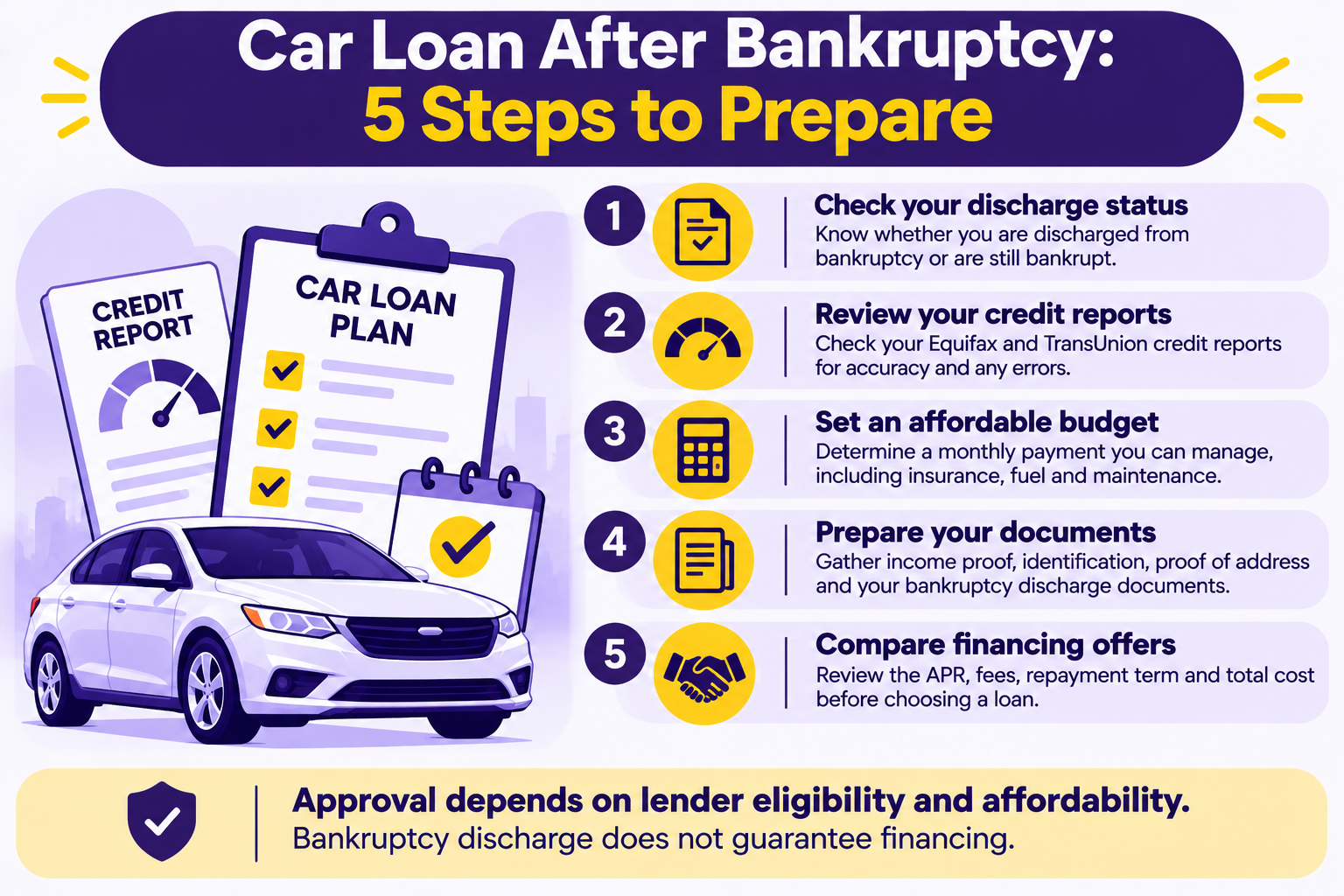
How to Improve Your Chances of Car Loan Approval After Bankruptcy
1. Check Your Credit Reports
Review your Equifax and TransUnion credit reports to identify inaccurate account information or bankruptcy details.
If you find errors, follow the relevant credit bureau’s dispute process.
2. Establish a Realistic Vehicle Budget
Determine how much you can afford each month after accounting for housing, groceries, utilities and other essential expenses.
Remember to include insurance, fuel, maintenance, registration and potential repairs.
3. Build a Positive Payment History
Make existing payments on time and avoid taking on unnecessary debt.
Where appropriate, a secured credit card may help establish a positive credit history if the issuer reports activity to Canadian credit bureaus.
There is no need to take out an expensive loan solely to rebuild credit.
4. Save a Down Payment Where Possible
A down payment reduces the amount you need to finance.
Choose an amount that still leaves sufficient funds for emergencies and ongoing vehicle expenses.
5. Choose an Affordable Vehicle
Consider reliability, insurance premiums, maintenance costs and total purchase price.
Confirm that the vehicle meets the financing provider’s eligibility requirements.
Explore our guide to used car loans in Canada.
6. Compare More Than the Monthly Payment
Review the APR, total interest, financing fees, repayment term and overall amount payable.
A smaller monthly payment can be appealing, but a longer repayment term may substantially increase total interest costs.
7. Prepare Your Documents Before Applying
Having accurate income, identity and discharge documentation ready may help reduce processing delays.
Can a Car Loan Help Rebuild Credit After Bankruptcy?
A car loan may help establish a more positive credit history if the lender reports the account and payment activity to Canadian credit bureaus.
Consistently making payments on time can contribute positively to your repayment record.
However, taking out a car loan does not guarantee that your credit score will improve by a specific amount or within a particular period.
Some financing providers may not report payment activity to both major credit bureaus.
Before accepting a loan primarily for credit-building purposes, ask whether the lender reports to Equifax Canada, TransUnion Canada or both.
Important: Do not take on an unaffordable vehicle loan just to improve your credit score. Missed payments can create further financial difficulties and damage your credit history.
For practical guidance, see the Financial Consumer Agency of Canada’s credit improvement advice.
Can You Refinance a Car Loan After Your Credit Improves?
Refinancing may be an option if your financial circumstances improve after taking out a car loan.
For example, a borrower who originally qualified at a relatively high interest rate may later explore alternative financing.
However, refinancing is subject to lender approval and vehicle eligibility.
Before refinancing, compare:
- The new interest rate and APR.
- Any refinancing fees.
- The outstanding loan balance.
- The remaining repayment term.
- The total cost of keeping the existing loan.
- The total cost of the proposed replacement loan.
A lower monthly payment does not necessarily mean refinancing will save money, particularly if the new loan extends the repayment period.
Learn more about car loan refinancing in Canada.
Warning Signs When Shopping for Post-Bankruptcy Car Financing
Borrowers with damaged credit may feel pressure to accept the first available financing offer.
Before signing, watch for:
- Guaranteed approval claims: Legitimate lenders still assess eligibility and repayment affordability.
- Unclear financing charges: Ask for a complete breakdown of fees and borrowing costs.
- Pressure to sign immediately: Take time to review the contract and compare options.
- Unnecessary add-ons: Check whether warranties, insurance or other products are optional.
- Very long repayment terms: These may increase total interest and the risk of owing more than the vehicle is worth.
- Unclear vehicle pricing: Compare the vehicle’s selling price independently from the financing arrangement.
- Requests for suspicious upfront payments: Verify the provider and understand exactly what any requested payment covers.
Read the full financing agreement and disclosure documents before committing.
Frequently Asked Questions About Car Loans After Bankruptcy in Canada
Can I get a car loan in Canada after bankruptcy?
Yes, some lenders consider applications from borrowers who have been discharged from bankruptcy. Approval depends on income, affordability, credit history, vehicle eligibility and the lender’s requirements.
Can I get a car loan while still bankrupt in Canada?
It may be difficult, and important legal obligations apply. An undischarged bankrupt must disclose their bankruptcy status when obtaining credit totalling $1,000 or more. Consult your Licensed Insolvency Trustee before taking on new financing.
How soon after bankruptcy discharge can I apply for a car loan?
There is no universal Canadian waiting period. Some lenders may consider applications relatively soon after discharge, while others require a longer period of positive financial history.
How long does bankruptcy stay on my credit report in Canada?
A first bankruptcy generally remains for six years after discharge with Equifax. TransUnion generally retains it for six years in most provinces and seven years in Ontario, Quebec, Prince Edward Island and Newfoundland and Labrador. Multiple bankruptcies generally remain for 14 years.
Do I need a down payment for a car loan after bankruptcy?
Not every lender has the same requirement. Some may require a down payment, while others assess it according to the borrower and vehicle. A down payment reduces the amount borrowed but does not guarantee approval.
What interest rate can I expect on a car loan after bankruptcy?
Rates vary by lender, credit history, income, affordability, vehicle and loan terms. Borrowers with recent bankruptcies may face higher rates, but there is no single APR range that applies to everyone.
What documents do I need for a car loan after bankruptcy?
Lenders may request identification, proof of income, employment information, bank statements, proof of address, vehicle details and bankruptcy discharge documents. Requirements vary by lender.
Can I finance a used car after bankruptcy?
Possibly. Some lenders consider used vehicle financing after bankruptcy, subject to credit assessment and vehicle requirements such as age, mileage, value and condition.
Can a co-signer help me qualify for a car loan after bankruptcy?
Some lenders may consider an eligible co-signer or joint borrower. This may strengthen an application, but approval is not guaranteed and the co-signer may be responsible for repayment under the agreement.
Will a car loan help rebuild my credit after bankruptcy?
It may help if the lender reports payment activity to Canadian credit bureaus. On-time payments can support a positive credit history, but improvement is not guaranteed and missed payments can harm your credit.
Final Thoughts: Getting a Car Loan After Bankruptcy in Canada
Bankruptcy can make car financing more challenging, but it does not permanently eliminate your borrowing options.
Some lenders consider applicants after bankruptcy discharge, particularly where they can demonstrate sufficient income and the ability to manage new repayments.
Before accepting financing, review your credit reports, establish a realistic budget, compare loan terms and avoid borrowing more than you can afford.
If you are still in bankruptcy, consult your Licensed Insolvency Trustee before seeking new credit.
For more guidance, explore our Canadian car loan guides or use our car loan calculator to estimate payments.
If you are ready to explore financing options after bankruptcy, you can apply online with ZoomCarLoans. Approval is not guaranteed and lender eligibility requirements apply.


The ZoomCarLoans Editorial Team brings you practical advice on car financing, credit building, and vehicle buying in Canada. Our goal is to make car loans easier to understand — and easier to get approved for.