Car Loans for Newcomers to Canada
February 20, 2026
Last updated: October 2026
Can newcomers to Canada get a car loan without Canadian credit history? Yes, it may be possible. Some Canadian lenders offer newcomer vehicle financing programs that consider applicants with limited or no established Canadian credit history. Approval still depends on the lender’s requirements, your immigration or residency documentation, income, affordability and the vehicle being financed.
For many newcomers, a vehicle is essential for commuting, family responsibilities and settling into a new community. However, applying for a first Canadian car loan can be confusing when you have little local borrowing history.
This guide explains how newcomer car financing works, who may qualify, what documents lenders request and how to compare loan offers without taking on more debt than you can comfortably afford.
What Is a Newcomer Car Loan in Canada?
A newcomer car loan is vehicle financing offered to applicants who are relatively new to Canada and may not have an established Canadian credit history.
Some banks and automotive finance companies have programs designed for eligible newcomers. Others assess applications through their standard lending criteria.
These programs may place additional emphasis on:
- Immigration or residency status.
- Proof of employment and income.
- Ability to afford the loan payments.
- Available down payment.
- Vehicle age and eligibility.
- Length of time in Canada.
Newcomer financing is not a separate category of loan with one national set of rules. Each lender establishes its own eligibility conditions, subject to applicable law.
Can You Get a Car Loan Without Canadian Credit History?
Yes. Some lenders consider newcomer applications even when the borrower does not have an established Canadian credit file.
For example, certain Canadian banks and automotive finance companies advertise newcomer programs that may accept eligible applicants without Canadian credit history.
However, no Canadian credit history does not mean guaranteed approval.
A lender may still assess your income, expenses, employment circumstances, existing financial obligations, immigration documentation and the proposed vehicle.
If you have already established some Canadian credit, the lender may review that history as part of its assessment.
For related guidance, read our article about car loans with no credit history in Canada.
Who Qualifies as a Newcomer for Car Financing?
The definition of a newcomer varies between financing programs.
Depending on the lender, potentially eligible applicants may include:
- Permanent residents: Individuals who have recently obtained Canadian permanent resident status.
- Temporary foreign workers: Applicants with qualifying work permits and employment arrangements.
- International students: Students with valid study permits, where the lender’s program permits applications from this group.
- Other eligible temporary residents: Applicants whose status and circumstances meet a particular lender’s criteria.
Not every lender accepts every immigration category.
Some programs also have specific time-since-arrival requirements. There is no universal rule that everyone who has lived in Canada for fewer than three years automatically qualifies.
Before applying, confirm the lender’s accepted residency categories, documentation requirements and any time limits.
Can Work Permit Holders Get a Car Loan in Canada?
Some lenders offer car financing to eligible temporary foreign workers, including applicants without an established Canadian credit history.
However, a valid work permit alone does not guarantee financing.
Lenders may consider:
- Whether your work permit is valid.
- How long the permit remains valid.
- Your employment contract and expected income.
- How long you have been employed.
- The proposed loan repayment term.
- Your existing debts and living expenses.
Some lenders may impose restrictions where the proposed financing term extends beyond the applicant’s authorized period of stay or employment. Others may use different eligibility rules.
Practical tip: If you hold a temporary work permit, ask about the lender’s permit-expiry and loan-term requirements before choosing a vehicle.
What Documents Do Newcomers Need for a Car Loan?
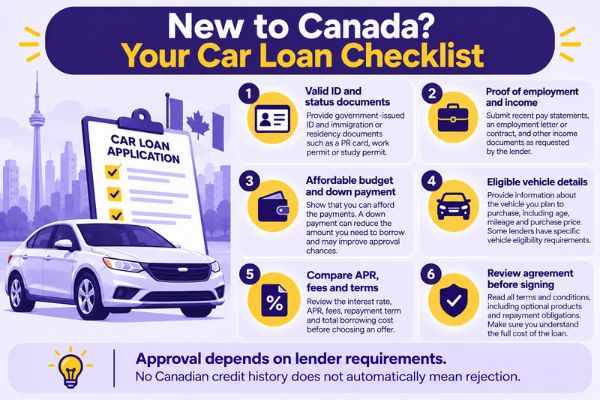
Documentation requirements vary by lender, but preparing the following information can help reduce application delays.
| Document | Why It May Be Requested |
|---|---|
| Government-issued identification | To verify your identity. |
| Permanent resident card, work permit or study permit | To confirm immigration or residency eligibility. |
| Recent pay statements | To verify employment income. |
| Employment letter or contract | To confirm employment details and expected earnings. |
| Bank statements | To help verify income, available funds or financial activity. |
| Proof of Canadian address | To confirm current residential information. |
| Down payment information | To verify available funds where a down payment is required. |
| Vehicle purchase details | To assess the proposed vehicle and financing amount. |
Some lenders may request additional information, while others may not require every item listed.
For a broader checklist, see our car loan documents guide.
Do Newcomers Need a Down Payment for a Car Loan?
Not every newcomer financing program has the same down payment requirement.
Some lenders require a minimum contribution from the borrower. Others may assess the down payment according to the applicant, vehicle and financing arrangement.
A down payment can reduce the amount you need to borrow and may help you meet certain lender eligibility requirements.
How a Down Payment Changes Your Loan Amount
Consider a hypothetical vehicle priced at $25,000 before taxes and other charges.
| Down Payment | Amount Financed Before Taxes and Fees |
|---|---|
| $0 | $25,000 |
| $2,500 (10%) | $22,500 |
| $5,000 (20%) | $20,000 |
Example assumptions: The table illustrates the effect of a down payment on a $25,000 vehicle purchase price. Taxes, fees, trade-ins and optional products are excluded. These percentages are examples, not minimum down payments required by Canadian lenders.
A larger down payment generally reduces the principal borrowed, but it does not guarantee approval or a lower interest rate.
Learn more in our Canadian car loan down payment guide.
Which Canadian Lenders Offer Newcomer Car Financing?
Several Canadian financial institutions and automotive finance providers advertise programs or financing options for eligible newcomers.
| Provider | Newcomer Financing Considerations |
|---|---|
| RBC | Advertises newcomer vehicle financing programs with eligibility criteria based on residency category, documentation and other requirements. |
| Scotiabank | Offers a newcomer auto financing program with specified residency and vehicle eligibility conditions. |
| TD Auto Finance | Advertises dealership-based financing that may be available to eligible newcomers with limited or no Canadian credit history. |
| Ford Credit | Advertises a newcomer program for qualifying applicants purchasing or leasing eligible vehicles. |
These are examples of publicly advertised programs, not endorsements, guaranteed approvals or a complete list of available lenders. Program terms and availability can change.
For current requirements, consult the providers directly:
- RBC newcomer car loans.
- Scotiabank newcomer auto financing.
- TD car loans for newcomers.
- Ford Credit newcomer program.
Check whether you must apply through a participating dealership, directly with the lender or through another approved application channel.
What Interest Rate Can a Newcomer Get on a Car Loan?
There is no single Canadian interest rate or APR range that applies to all newcomers.
The financing rate offered may depend on:
- The lender and financing program.
- Income and affordability.
- Canadian credit history, if available.
- Other information accepted by the lender.
- Down payment and loan amount.
- Vehicle age, condition and value.
- Loan repayment term.
- Available manufacturer financing promotions.
A newcomer with no Canadian credit history does not automatically receive the highest available interest rate, and a strong income does not guarantee a particular APR.
Compare actual financing offers rather than relying on advertised rates or generic newcomer rate estimates.
For broader context, read our guide to car loan interest rates in Canada.
How Much Would a Newcomer Car Loan Cost Each Month?
Before choosing a vehicle, calculate what the loan could cost under different financing scenarios.
For illustration, consider a $20,000 car loan over 60 months.
| Hypothetical Fixed Interest Rate | Approx. Monthly Payment | Approx. Total Interest |
|---|---|---|
| 6% | $387 | $3,199 |
| 9% | $415 | $4,910 |
| 12% | $445 | $6,693 |
Example assumptions: $20,000 principal, fixed annual interest rates, monthly compounding and 60 equal monthly payments. Figures are rounded. Taxes, financing fees, down payments and optional products are excluded. These are hypothetical scenarios, not advertised newcomer loan rates.
Even when the loan amount stays the same, the interest rate can significantly affect your monthly payment and total interest costs.
Use our car loan calculator to estimate payments based on your own budget.
What Other Vehicle Costs Should Newcomers Budget For?
The loan payment is only one part of owning a vehicle in Canada.
Other costs can include:
- Auto insurance: Premiums depend on factors such as province, vehicle, coverage and driving history. Newcomers should obtain actual quotes before buying.
- Fuel or charging: Estimate costs based on commuting distance and driving habits.
- Maintenance and repairs: Budget for regular servicing, tires and unexpected repairs.
- Registration and licensing: Requirements and fees vary by province or territory.
- Winter driving expenses: Winter tires or other seasonal costs may apply depending on the location and vehicle.
- Parking and tolls: These can be significant in some cities.
Before accepting a loan, compare the total monthly ownership cost with your take-home income and essential living expenses.
Should Newcomers Get Car Loan Pre-Approval?
Pre-approval or an initial financing assessment may help you understand potential borrowing limits and lender requirements before committing to a vehicle.
However, the meaning of pre-approval varies by provider.
Some preliminary assessments are based on limited information, while others involve a credit check or more detailed verification.
Ask the lender:
- Whether the assessment involves a hard credit enquiry.
- Whether your immigration status meets its requirements.
- Whether the proposed vehicle is eligible.
- Whether the quoted rate is conditional.
- How long the assessment remains valid.
- What additional documents are required for final approval.
Remember: Pre-approval does not necessarily guarantee final financing approval.
Learn more about car loan pre-approval in Canada.
Can Newcomers Finance New and Used Cars?
Depending on the lender, eligible newcomers may be able to finance new vehicles, used vehicles or certified pre-owned vehicles.
However, some newcomer programs impose restrictions on the age or type of vehicle being financed.
A lender may consider:
- Vehicle age and mileage.
- Purchase price and assessed value.
- Vehicle condition and history.
- Whether the purchase is through a dealership.
- Loan amount and repayment term.
Before paying a deposit, confirm that the lender will finance the specific vehicle you intend to purchase.
For more information, explore our guide to used car loans in Canada.
Can a Co-Signer Help a Newcomer Get a Car Loan?
Some lenders may consider an application supported by an eligible co-signer or joint borrower.
A co-signer with an established Canadian credit profile and sufficient income may strengthen an application, depending on the lender’s policies.
However, a co-signer does not guarantee approval.
Co-signing also creates a serious financial responsibility. Depending on the agreement, the co-signer may be legally responsible for repayment if the primary borrower does not pay.
Both parties should understand the contract, repayment obligations and potential credit consequences before proceeding.
Can an International Credit History Help?
Canadian credit bureaus generally maintain records of credit activity reported in Canada.
However, some lenders may consider foreign credit information or additional financial documentation when assessing a newcomer application.
This is not a universal practice, and a strong credit score from another country does not automatically translate into an equivalent Canadian credit score.
If you have an established credit history abroad, ask whether the lender accepts international credit reports or other supporting documentation.
Can a Car Loan Help Build Canadian Credit History?
A car loan may help establish or strengthen Canadian credit history when the lender reports the account and payment activity to Canadian credit bureaus.
Making payments on time can contribute positively to your repayment history.
However, not every financing provider necessarily reports information in the same way, and a car loan does not guarantee a particular credit score improvement.
Before applying, you can ask whether the lender reports payment activity to Equifax Canada, TransUnion Canada or both.
Borrow only what you can comfortably afford. Missing payments or taking on excessive debt can damage your credit profile.
For more information, see the Financial Consumer Agency of Canada’s guidance on improving your credit score.
How to Apply for a Car Loan as a Newcomer to Canada
- Set a realistic budget. Include insurance, fuel, maintenance and other ownership expenses.
- Check your immigration eligibility. Confirm which lenders or programs accept your residency category and documents.
- Prepare proof of income. Gather pay statements, employment information and any other requested records.
- Review your Canadian credit file. If you have one, check it for errors before applying.
- Explore financing options. Compare newcomer programs, dealership financing and other eligible lenders.
- Consider your down payment. Determine how much you can contribute without exhausting emergency savings.
- Check vehicle restrictions. Confirm the car meets the lender’s age, mileage and eligibility requirements.
- Compare the full financing terms. Review APR, fees, repayment term, total borrowing cost and payment schedule.
- Read the agreement before signing. Make sure you understand all charges, optional products and contractual obligations.
The Financial Consumer Agency of Canada recommends shopping around for vehicle financing and comparing the full terms rather than focusing only on monthly payments.
Common Mistakes Newcomers Should Avoid
- Assuming no Canadian credit means automatic rejection: Some lenders have programs specifically designed for eligible newcomers.
- Assuming approval is guaranteed: Newcomer programs still have eligibility and affordability requirements.
- Ignoring permit expiry: Temporary residency documentation may affect available financing options.
- Shopping only by monthly payment: Longer terms can increase total interest costs.
- Not checking insurance costs: Insurance premiums can materially affect the overall vehicle budget.
- Paying a non-refundable deposit too early: Confirm financing and understand deposit terms before committing.
- Accepting unnecessary add-ons: Review optional warranties, insurance and other products carefully.
- Submitting repeated applications without understanding credit checks: Ask whether an application involves a hard enquiry and how your information will be used.
Frequently Asked Questions About Car Loans for Newcomers to Canada
Can newcomers get car loans without Canadian credit history?
Yes. Some Canadian lenders offer newcomer financing programs for eligible applicants with limited or no established Canadian credit history. Approval still depends on income, affordability, documentation, vehicle eligibility and lender requirements.
Can I get a car loan in Canada with a work permit?
Some lenders finance eligible work permit holders. They may assess employment, income, permit validity and the proposed loan term. A valid work permit does not guarantee approval.
Can international students get car loans in Canada?
Some newcomer financing programs may accept eligible international students with valid study permits. Requirements vary, so confirm student eligibility directly with the lender.
How long must I live in Canada before applying for a car loan?
There is no universal minimum residency period for every Canadian car lender. Some newcomer programs are designed for recent arrivals, while others have specific eligibility conditions.
Do newcomers need a down payment for a car loan?
Some newcomer programs require a down payment, while requirements differ between lenders. A larger down payment reduces the amount borrowed but does not guarantee approval or a particular interest rate.
What documents do newcomers need for car financing?
Lenders may request identification, immigration documents, proof of income, employment information, proof of address and vehicle details. Exact requirements depend on the lender and applicant.
Are car loan interest rates higher for newcomers?
Not necessarily. Rates depend on the lender, credit information, affordability, vehicle and financing terms. There is no single Canadian APR range that applies to all newcomers.
Can I finance a used car as a newcomer to Canada?
Possibly. Some lenders finance eligible used vehicles for newcomers, but restrictions may apply based on vehicle age, mileage, condition or the financing program.
Can a co-signer help me qualify for a newcomer car loan?
Some lenders may consider an eligible co-signer or joint borrower. This can strengthen an application in certain circumstances, but approval is not guaranteed and the co-signer may share legal repayment responsibility.
Can a newcomer car loan help build Canadian credit?
It may help if the lender reports the account and payment activity to Canadian credit bureaus. On-time payments can support your credit history, while missed payments can harm it.
Final Thoughts: Getting a Car Loan as a Newcomer to Canada
Having limited or no Canadian credit history does not automatically prevent you from financing a vehicle.
Some lenders offer newcomer programs that consider eligible applicants based on income, documentation, affordability and other lending requirements.
Before applying, compare your options carefully, check any residency or vehicle restrictions and make sure the total cost of ownership fits your budget.
Explore our Canadian car loan guides or use the car loan calculator to estimate repayments.
If you are ready to explore available vehicle financing options, you can apply online with ZoomCarLoans. Approval is not guaranteed, and lender eligibility requirements apply.


The ZoomCarLoans Editorial Team brings you practical advice on car financing, credit building, and vehicle buying in Canada. Our goal is to make car loans easier to understand — and easier to get approved for.