Bank vs Dealership Car Financing in Canada
February 02, 2026
Last updated: November 2026
Is it better to get car financing from a bank or dealership in Canada? Neither option is automatically cheaper or easier to qualify for. Bank financing allows you to approach a financial institution directly, while dealership financing generally involves the dealer arranging a loan through a bank, manufacturer finance company or another lender. The better option depends on your approved rate, fees, vehicle price, loan term and total repayment cost.
When buying a vehicle, choosing where to arrange financing can be just as important as choosing the car itself. A convenient monthly payment may look attractive, but it does not necessarily mean you are getting the lowest borrowing cost.
This guide compares bank vs dealership car financing in Canada, including how approvals work, interest rates, credit requirements, promotional offers, financing fees and the questions to ask before signing.
For more information about vehicle financing, explore our Canadian car loan guides.
Bank vs Dealership Car Financing: Quick Comparison
The main difference is how you arrange the loan, not necessarily who ultimately provides the money.
| Feature | Direct Bank Financing | Dealership-Arranged Financing |
|---|---|---|
| Where you apply | Directly with a bank or other financial institution. | Through a dealership that arranges financing with an eligible lender. |
| Who provides the loan | The financial institution or lender you approach. | A bank, credit union, manufacturer finance company or independent lender. |
| Interest rates | Depend on the lender, applicant and loan terms. | Depend on the lender, applicant, vehicle and available programs. |
| Credit requirements | Set by the lender. | Set by the lender receiving the dealership application. |
| Pre-approval | May be available before vehicle selection. | May be available, depending on the dealership and lender. |
| Manufacturer promotions | May not provide access to every manufacturer-backed offer. | May provide access to eligible manufacturer promotional financing. |
| Vehicle eligibility | Subject to the lender’s restrictions. | Subject to the financing provider’s restrictions. |
| Convenience | Can help you establish financing terms before visiting a dealer. | May combine vehicle purchase and financing arrangements in one place. |
| Potential drawbacks | Available loan products and eligible vehicles may be limited. | Not every lender or its lowest available rate will necessarily be presented. |
Key takeaway: Compare actual written financing offers rather than assuming one application channel is always better.
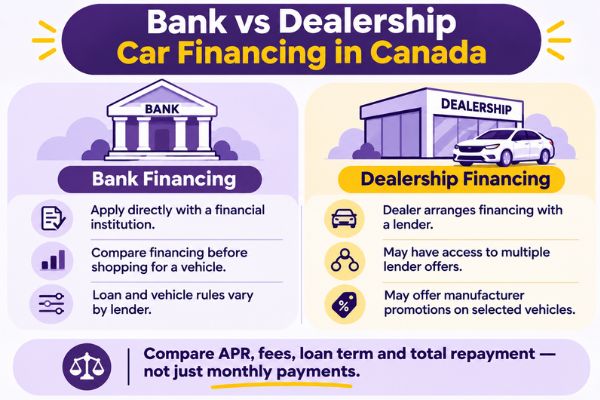
How Does Bank Car Financing Work in Canada?
With direct bank financing, you contact a bank or other financial institution to discuss borrowing for a vehicle purchase.
Depending on the institution, you may be offered a dedicated auto loan, personal loan or another borrowing product suitable for purchasing a vehicle.
The lender assesses your application using its own credit and affordability requirements.
Potential Advantages of Bank Financing
- Compare financing before shopping: You may be able to establish a budget or obtain conditional pre-approval before choosing a vehicle.
- Direct communication: You can discuss the financing agreement and borrowing costs with the institution providing the loan.
- Existing banking relationship: Some institutions may consider your broader relationship when assessing eligible products.
- Negotiating position: Having a financing offer can provide a useful comparison when the dealership presents its own options.
Potential Disadvantages of Bank Financing
- Not every bank offers the same vehicle financing products.
- Some loans have restrictions on vehicle age, mileage or purchase source.
- Approval may require additional documentation or vehicle information.
- You may not have access to certain manufacturer promotional financing programs.
Bank financing is not reserved exclusively for borrowers with excellent credit. Eligibility depends on the particular institution and financing product.
How Does Dealership Car Financing Work in Canada?
With dealership-arranged financing, the dealer helps you apply for a vehicle loan through one or more financing providers.
These providers may include:
- Banks and credit unions.
- Automotive manufacturer finance divisions.
- Independent vehicle financing companies.
- Lenders serving applicants with different credit profiles.
The dealership generally acts as an intermediary. The actual lender determines whether to approve the application and what financing terms to offer.
Some dealerships work with several lenders, while others have a more limited financing network.
Potential Advantages of Dealership Financing
- Convenience: Vehicle selection and financing may be handled during the same purchase process.
- Multiple financing partners: Some dealers can submit applications to more than one lender.
- Manufacturer promotions: Eligible buyers may have access to promotional financing on selected vehicles.
- Different lending criteria: A dealership’s lender network may include providers with different eligibility requirements.
Potential Disadvantages of Dealership Financing
- The dealer may not show you every financing offer available through its partners.
- The rate presented may not be the lowest rate you could obtain elsewhere.
- Dealer compensation arrangements may create incentives to recommend certain financing offers.
- Additional products or charges may increase the overall transaction cost.
- Financing discussions can become complicated when the vehicle price, trade-in value and loan terms are negotiated together.
Important: Dealership financing does not guarantee faster approval or greater flexibility. Those outcomes depend on the dealership, lender, applicant and proposed vehicle.
Is Bank or Dealership Financing Cheaper?
Neither option is consistently cheaper.
A bank may offer a competitive rate on a standard vehicle loan, while a dealership may have access to a manufacturer-backed promotional offer or a different lender willing to provide more favourable terms.
However, dealership-arranged financing may also include a higher quoted rate or additional costs.
The Financial Consumer Agency of Canada recommends comparing offers from multiple lenders and dealerships, including interest rates, fees, loan terms and total borrowing costs.
Example: Comparing Two Car Loan Offers
Suppose you receive two hypothetical offers to finance the same $20,000 vehicle over 60 months.
| Loan Detail | Bank Offer | Dealership Offer |
|---|---|---|
| Amount financed | $20,000 | $20,000 |
| Fixed annual interest rate | 7% | 9% |
| Repayment term | 60 months | 60 months |
| Approximate monthly payment | $396 | $415 |
| Approximate total interest | $3,761 | $4,910 |
| Approximate total loan repayment | $23,761 | $24,910 |
Example assumptions: Both loans have a $20,000 principal, fixed annual interest rates, monthly compounding and 60 equal monthly payments. Amounts are rounded. The illustration excludes taxes, financing fees, down payments and optional products. These are hypothetical offers, not advertised bank or dealership rates.
In this example, the bank offer costs approximately $1,149 less in total interest.
But this does not prove that banks always offer cheaper financing. If the dealership offered the lower rate instead, the result could be reversed.
The correct comparison is between the actual offers available to you.
APR vs Interest Rate: What Should You Compare?
When comparing vehicle financing, distinguish between the stated interest rate and the annual percentage rate (APR).
- Interest rate: The rate used to calculate interest on the outstanding loan balance.
- APR: An annualized measure of borrowing costs calculated under applicable disclosure rules. It may include qualifying non-interest borrowing charges.
APR and the stated interest rate may be identical in some circumstances. Not every purchase fee or optional product is necessarily included in APR.
For a meaningful comparison, review:
- The disclosed APR.
- The amount financed.
- The repayment term.
- The monthly or biweekly payment.
- Additional fees and charges.
- The total cost of borrowing.
- The total amount payable.
Read our detailed APR vs interest rate guide for Canadian car loans.
Does a Dealership Have to Offer the Lowest Interest Rate?
No. A dealership is not necessarily required to present the lowest rate available to you.
The Financial Consumer Agency of Canada advises borrowers to ask dealerships about multiple financing offers where possible and compare them with alternatives from other financial institutions.
Some dealers receive compensation from lenders for arranging financing. Depending on the arrangement, this can create an incentive to recommend one financing offer over another.
Ontario’s motor vehicle sales regulator, OMVIC, also advises consumers to compare the terms of dealership-arranged financing and understand the potential role of dealer compensation.
Questions to ask:
- Which lender is providing this loan?
- Were other lenders willing to approve my application?
- Can I see the rates and terms of other available offers?
- Does the dealership receive compensation for arranging this financing?
- Are there financing arrangement or placement fees?
- Can I arrange financing independently instead?
See OMVIC’s consumer guidance on car loans.
How Does Your Credit Score Affect Bank and Dealership Financing?
Your credit profile can influence the financing terms offered through either channel.
Banks, credit unions, automotive finance companies and other lenders may review information such as:
- Credit reports and repayment history.
- Existing debts.
- Income and employment circumstances.
- Debt affordability.
- Loan amount and repayment term.
- Vehicle age and value.
There is no universal credit score that guarantees approval through a bank or dealership.
Dealerships with multiple lending partners may have access to different underwriting criteria, but this does not mean every applicant will qualify.
For a deeper explanation, see car loan rates by credit score in Canada.
Is Dealership Financing Better for Bad Credit?
Dealership-arranged financing may be worth exploring if you have limited or damaged credit, particularly when the dealer works with lenders that consider a wider range of credit profiles.
However, the actual financing terms may be expensive.
Before accepting an offer, compare the interest rate, APR, fees, vehicle price and total repayment amount.
Borrowers rebuilding credit should also avoid accepting an unaffordable loan solely to establish a payment history.
If you have previously experienced insolvency, our guides to car loans after bankruptcy and car loans after a consumer proposal explain additional considerations.
Can You Get Pre-Approved Through a Bank or Dealership?
Some banks and dealership financing providers offer preliminary assessments or conditional pre-approvals.
However, pre-approval is not a guarantee of final financing.
A lender may still need to verify income, review credit information and approve the specific vehicle.
Why Arrange Financing Before Visiting a Dealership?
Obtaining a financing quote or conditional pre-approval before shopping can help you:
- Estimate an affordable borrowing amount.
- Understand potential financing costs.
- Compare the dealership’s offer with an independent alternative.
- Avoid choosing a vehicle based only on the monthly payment.
Ask whether the assessment involves a hard credit enquiry and whether the quoted terms are conditional.
Learn more about car loan pre-approval in Canada.
What About 0% or Promotional Dealership Financing?
Some automotive manufacturers advertise promotional financing on selected new vehicles.
These offers may be arranged through participating dealerships and manufacturer-affiliated finance companies.
Promotional financing can be attractive, but eligibility conditions may include:
- Specific vehicle models or trims.
- Limited promotional periods.
- Qualifying credit profiles.
- Maximum financing terms.
- Restrictions on combining financing promotions with cash rebates.
A promotional rate is not automatically the cheapest overall purchase option.
For example, choosing promotional financing might mean giving up a cash rebate available with another payment method.
Compare the total vehicle price and financing costs under each eligible offer before deciding.
Does Vehicle Age Affect Bank vs Dealership Financing?
Yes. Vehicle age, mileage, condition and value can affect loan eligibility.
However, it is inaccurate to assume banks always have stricter vehicle limits or that dealership lenders will finance any older vehicle.
Both channels may involve lenders with vehicle restrictions.
Some lenders may finance older vehicles only under certain conditions or through different loan products.
Before paying a deposit, confirm that your chosen lender will finance the specific vehicle.
Read more about used car financing in Canada.
How Do Down Payments Affect Financing?
A down payment reduces the amount borrowed, regardless of whether financing is arranged through a bank or dealership.
For example, on a $25,000 vehicle before taxes and fees:
| Down Payment | Amount Financed Before Taxes and Fees |
|---|---|
| $0 | $25,000 |
| $2,500 | $22,500 |
| $5,000 | $20,000 |
Example excludes sales taxes, dealer charges, optional products and trade-in adjustments. Down payment requirements vary by lender.
A larger down payment may reduce total borrowing costs, but it does not guarantee a lower interest rate or approval.
See our car loan down payment guide.
Can Longer Loan Terms Make Dealership Financing Look Cheaper?
Yes. A longer repayment term can reduce the required monthly payment while increasing the total interest paid.
This can make one financing offer appear more affordable even when it costs more overall.
For a fair comparison, ask lenders to quote the same:
- Vehicle purchase price.
- Down payment.
- Amount financed.
- Repayment term.
- Payment frequency.
Then compare interest, APR, fees and total repayment.
Long repayment terms can also increase the risk of negative equity, where the outstanding loan balance exceeds the vehicle’s value.
The FCAC warns consumers to consider total costs rather than focusing only on monthly payments.
What Fees Should You Check Before Signing?
Financing arrangements may involve charges beyond the stated interest.
Depending on the transaction, these can include:
- Financing arrangement or placement fees.
- Dealer administration fees.
- Optional warranties or protection products.
- Credit or loan insurance products.
- Other charges associated with the purchase or financing agreement.
Not every fee is necessarily a borrowing cost included in APR. The applicable disclosure rules determine which charges must be included.
Ask for a written breakdown of all costs and clarify which products are optional.
For example, British Columbia’s Vehicle Sales Authority has reminded dealers that qualifying finance placement fees must be reflected in disclosed APR calculations.
See the Vehicle Sales Authority of BC’s March 2026 financing disclosure bulletin.
Are Consumer Protections Different for Bank and Dealership Financing?
Your legal protections depend partly on the actual lender and the laws governing the transaction.
When a car loan is provided by a federally regulated financial institution, applicable federal consumer protection rules apply.
Other financing arrangements may be subject to provincial or territorial requirements.
Dealership sales practices are also regulated under applicable provincial or territorial laws.
Regardless of the financing channel, review the required disclosure documents before signing and confirm the interest rate, APR, fees, payment schedule and total borrowing cost.
In most Canadian provinces and territories, consumers should not assume they have an automatic cooling-off period after signing a vehicle purchase or financing agreement.
For more information, see the FCAC’s guide to consumer protections when financing a car.
When Does Bank Financing Make More Sense?
Direct bank financing may be worth considering when:
- You want to compare financing before visiting dealerships.
- Your financial institution offers a competitive loan product.
- You prefer to deal directly with the lender.
- You want an independent financing quote to compare with dealer offers.
- The vehicle meets the lender’s eligibility requirements.
However, a bank offer should still be compared with other available financing options.
When Does Dealership Financing Make More Sense?
Dealership-arranged financing may be worth considering when:
- You want the convenience of arranging financing during the vehicle purchase.
- The dealer can obtain offers from several eligible lenders.
- You qualify for a competitive manufacturer-backed promotion.
- A dealership financing partner offers better overall terms than your independent quote.
- You prefer to coordinate the vehicle purchase and financing through one provider.
The key is to confirm the actual terms rather than relying on general claims about easier approvals or lower payments.
How to Compare Bank and Dealership Financing Offers
Use this checklist before making a decision.
- Confirm the vehicle price. Compare the actual purchase price separately from financing.
- Obtain an independent quote. Ask a bank or credit union about available vehicle financing.
- Request the dealership’s financing offer. Ask which lender is providing the loan.
- Compare the same loan amount and term. Avoid comparing a shorter bank loan with a much longer dealership loan without accounting for total cost.
- Review APR and fees. Check all required disclosures and additional charges.
- Check manufacturer incentives. Compare promotional financing with any alternative cash rebates.
- Confirm optional products. Ask whether insurance, warranties or other add-ons are required or optional.
- Review the total repayment amount. Calculate the full borrowing cost, not just the monthly payment.
- Read the agreement before signing. Check the payment schedule, lender details, conditions and any relevant early repayment terms.
Use our car loan calculator to estimate monthly payments and total interest under different financing scenarios.
Frequently Asked Questions About Bank vs Dealership Car Financing in Canada
Is bank financing cheaper than dealership financing in Canada?
Not always. Either option may offer a lower borrowing cost depending on the lender, vehicle, interest rate, fees and repayment term. Compare actual written offers rather than assuming one channel is cheaper.
Is it easier to get approved through a dealership or bank?
Approval depends on the lender’s credit and affordability requirements. Some dealerships work with multiple lenders, which may provide additional options, but dealership financing does not guarantee easier approval.
Can I get pre-approved through a bank before visiting a dealership?
Some banks and financial institutions offer conditional vehicle financing pre-approval. This can help establish a budget and provide a financing offer to compare with the dealership’s terms.
Can a dealership offer a lower interest rate than a bank?
Yes. A dealership may arrange a competitive loan through a financing partner or offer access to eligible manufacturer promotional financing. However, a dealership’s rate is not necessarily the lowest available.
Does a dealership have to show me the lowest financing rate?
Not necessarily. Ask which lenders considered your application and whether other financing offers are available. Compare the quoted terms with independent financing options.
Does dealership financing affect my credit score?
A financing application may involve a hard credit enquiry. Dealerships may submit applications to multiple lenders, so ask how your information will be used and which credit checks may occur.
Is dealership financing better for bad credit?
Some dealerships work with lenders that consider different credit profiles, but approval is not guaranteed. Compare interest rates, APR, fees and total repayment costs carefully before accepting an offer.
Can I finance an older used car through a bank or dealership?
Possibly. Both banks and dealership financing providers may impose restrictions on vehicle age, mileage, condition and value. Eligibility depends on the specific lender and vehicle.
Is 0% dealership financing always the cheapest option?
No. Promotional financing may have eligibility restrictions and may not be available with certain cash rebates. Compare the total purchase and financing costs of all eligible offers.
What should I compare before choosing bank or dealership financing?
Compare the vehicle price, amount financed, APR, interest rate, fees, repayment term, payment schedule, optional products and total amount payable. The lowest monthly payment is not necessarily the lowest-cost option.
Final Thoughts: Bank or Dealership Car Financing in Canada?
Bank financing and dealership-arranged financing can both provide suitable vehicle loans, but neither is automatically the best choice for every Canadian borrower.
Direct bank financing may help you establish an independent offer before shopping. Dealership financing may provide convenience, access to different lending partners or eligible manufacturer promotions.
The best approach is to compare the actual financing terms, understand the full cost of borrowing and choose payments that fit comfortably within your budget.
For more guidance, explore our Canadian car loan guides and review car loan rates in Canada.
If you are ready to explore available financing options, you can apply online with ZoomCarLoans. Approval is not guaranteed and lender eligibility requirements apply.


The ZoomCarLoans Editorial Team brings you practical advice on car financing, credit building, and vehicle buying in Canada. Our goal is to make car loans easier to understand — and easier to get approved for.