
What Can You Buy With a $10,000 Car Loan in Canada?
November 03, 2026
Last updated: November 2026
What can you buy with a $10,000 car loan in Canada? A $10,000 car loan may help you buy an older used vehicle, such as a Toyota Corolla, Honda Civic, Mazda3 or Nissan Micra. However, the car’s price, age, mileage and condition will affect your options. Sales taxes, fees and lender requirements can also limit what you can afford.
A $10,000 budget can still provide useful choices if you focus on reliability and overall ownership costs rather than finding the newest vehicle.
This guide explains which used cars to consider, how taxes and fees affect your budget, what monthly payments could look like and how to compare financing options before buying.
What Kind of Car Can You Buy for $10,000 in Canada?
A $10,000 budget will generally put you in the used-car market. Many vehicles within this price range are older or have higher mileage than more expensive alternatives.
The type of car you can buy depends on where you live, local vehicle prices and the condition of available cars.
Examples worth researching include:
- Toyota Corolla: A compact sedan known for practical everyday driving and fuel economy.
- Honda Civic: A popular choice for commuting, with a wide selection of older used models.
- Mazda3: A compact car that can offer good value and comfortable handling.
- Nissan Micra: A smaller, affordable option for city driving.
- Toyota Camry: A larger sedan that may suit families needing more passenger space.
These are examples of vehicles to research, not guaranteed options available for $10,000. Prices vary by province, mileage, vehicle history and condition.
Important: A car that fits your budget may not qualify for financing. Some lenders restrict the age, mileage or minimum value of vehicles they will finance.
Best Used Cars to Consider With a $10,000 Budget
The cheapest vehicle is not always the best purchase. A well-maintained car with a good service history may cost less to own than a newer vehicle needing expensive repairs.
The following models are worth comparing when shopping on a limited budget.
1. Toyota Corolla
The Toyota Corolla is a practical choice for drivers who want affordable daily transport.
Older models can offer good fuel economy, widely available replacement parts and a strong reputation for reliability.
Model years to research: Approximately 2010–2016.
Why consider it?
- Suitable for commuting and everyday driving.
- Generally economical on fuel.
- Widely available replacement parts.
- Practical for individuals, couples and small families.
What to check: Rust, suspension condition, service records, brakes and outstanding recalls.
2. Honda Civic
The Honda Civic is another popular used-car option in Canada.
It offers a balance of fuel economy, comfort and everyday performance.
Model years to research: Approximately 2010–2016.
Why consider it?
- Good fuel economy for regular commuting.
- Comfortable city and highway driving.
- A wide selection of used vehicles.
- Strong resale appeal.
What to check: Transmission performance, rust, air conditioning, maintenance history and recalls.
3. Mazda3
The Mazda3 may appeal to buyers looking for an affordable compact car with comfortable handling.
Older models are available as sedans and hatchbacks.
Model years to research: Approximately 2012–2017.
Why consider it?
- Often competitively priced.
- Good everyday driving performance.
- Practical sedan and hatchback options.
- Reasonable fuel economy.
What to check: Rust, suspension, brakes, electronics and service records.
4. Nissan Micra
The Nissan Micra is a smaller vehicle that may suit drivers who mainly travel around town.
Its compact size makes parking easier, particularly in busy urban areas.
Model years to research: Approximately 2015–2019.
Why consider it?
- Compact and easy to park.
- Generally economical on fuel.
- Often less expensive than larger vehicles.
- Suitable for short daily journeys.
What to check: Transmission or clutch condition, suspension, rust and maintenance records.
5. Toyota Camry
A used Toyota Camry may be worth considering if you need more passenger space than a compact car provides.
Within a $10,000 budget, you may need to look at older models or vehicles with higher mileage.
Model years to research: Approximately 2009–2015.
Why consider it?
- Comfortable for longer journeys.
- More passenger space than many compact cars.
- Practical for family transport.
- A well-established used-car market.
What to check: Engine condition, oil consumption, transmission, rust and service history.
Comparing Used Cars Under $10,000 in Canada
| Vehicle | Example Model Years | Best Suited For |
|---|---|---|
| Toyota Corolla | 2010–2016 | Everyday reliability and commuting |
| Honda Civic | 2010–2016 | Comfort and fuel economy |
| Mazda3 | 2012–2017 | Value and driving comfort |
| Nissan Micra | 2015–2019 | Affordable city driving |
| Toyota Camry | 2009–2015 | Families needing more space |
Note: These model years are illustrative examples to research, not verified current listings or guaranteed price ranges. Vehicle availability, condition and financing eligibility vary. Always compare current local listings before setting your budget.
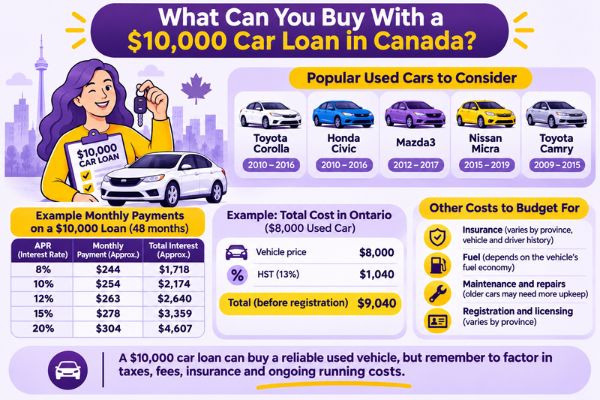
You can research asking prices through AutoTrader Canada or CarGurus Canada.
Does a $10,000 Car Loan Mean You Can Buy a $10,000 Car?
Not necessarily. The advertised price of a used vehicle may not include every cost you need to pay.
Sales taxes, registration costs and other charges can increase the final purchase price.
For example, consider a used vehicle advertised for $10,000 at an Ontario dealership.
| Purchase Cost | Example Amount |
|---|---|
| Advertised vehicle price | $10,000 |
| Ontario HST at 13% | $1,300 |
| Total before registration and other costs | $11,300 |
Example assumptions: Ontario dealership purchase with 13% HST, no trade-in and no additional charges. The advertised price is assumed to be before HST. Ontario’s dealer advertising rules generally require mandatory dealer charges to be included in advertised prices, apart from HST and licensing.
In this example, the final price already exceeds your $10,000 loan amount by $1,300.
If the lender approves a maximum loan of $10,000, you may need to pay the difference yourself or choose a less expensive vehicle.
Some lenders may allow eligible taxes and charges to be financed, depending on their requirements.
What If You Buy an $8,000 Car Instead?
Choosing a vehicle below your maximum budget can leave more room for taxes and other expenses.
Consider an $8,000 used vehicle purchased from an Ontario dealership.
| Purchase Cost | Example Amount |
|---|---|
| Vehicle price | $8,000 |
| Ontario HST at 13% | $1,040 |
| Total after HST | $9,040 |
This leaves $960 within a $10,000 total budget for other purchase costs.
However, registration, insurance, inspections and repairs could use up some or all of that amount.
Key takeaway: If $10,000 is your total spending limit, shopping for vehicles priced below $10,000 may help you avoid borrowing more than planned.
How Much Sales Tax Will You Pay on a Used Car in Canada?
Sales tax varies by province and can make a noticeable difference to the final cost.
The amount may also depend on whether you purchase from a registered dealership or a private seller.
Example Sales Tax on an $8,000 Dealership Purchase
| Province | Example Sales Tax | Tax on $8,000 |
|---|---|---|
| Ontario | 13% | $1,040 |
| Alberta | 5% | $400 |
| British Columbia | 12% | $960 |
| Quebec | 14.975% | $1,198 |
| Nova Scotia | 14% | $1,120 |
Example assumptions: Standard taxable dealership sale of an $8,000 passenger vehicle, with no trade-in, exemption or special adjustment. British Columbia has different PST rates for higher-priced passenger vehicles. Quebec’s amount combines GST and QST. Figures are rounded where appropriate.
These differences show why it is important to check the total purchase cost rather than comparing advertised vehicle prices alone.
For current federal GST/HST information, visit the Canada Revenue Agency’s GST/HST calculator.
Do You Pay Sales Tax When Buying From a Private Seller?
The rules vary across Canada.
- Ontario: Private buyers generally pay 13% retail sales tax when registering a used vehicle. The tax is usually based on the purchase price or wholesale value, whichever is higher.
- Alberta: A typical private sale between individuals is generally not subject to GST or provincial sales tax.
- British Columbia: Provincial sales tax generally applies to privately purchased used passenger vehicles.
Some provinces have exemptions or special rules.
Official source: Government of Ontario — Buying or Selling a Used Vehicle.
How Much Is a $10,000 Car Loan Per Month in Canada?
Your monthly payment depends on the loan amount, interest rate and repayment term.
A lower interest rate generally reduces the total cost of borrowing, while a longer repayment term can lower monthly payments but increase total interest.
Monthly Payments on a $10,000 Car Loan Over 48 Months
| Annual Interest Rate | Approx. Monthly Payment | Approx. Total Interest |
|---|---|---|
| 8% | $244 | $1,718 |
| 10% | $254 | $2,174 |
| 12% | $263 | $2,640 |
| 15% | $278 | $3,359 |
| 20% | $304 | $4,607 |
Example assumptions: $10,000 financed over 48 months at a fixed annual interest rate, with monthly compounding and equal monthly payments. Figures are approximate and rounded. Taxes, fees, optional products and other charges are excluded. Rates are illustrative and are not lender quotes.
At 10%, the estimated payment is approximately $254 per month.
At 20%, it increases to approximately $304 per month.
That is a difference of roughly $2,433 in total interest over four years.
Use our car loan calculator to compare different loan amounts, interest rates and repayment terms.
You can also review our guide to car loan rates in Canada.
Does a Longer Loan Term Make a $10,000 Car Loan Cheaper?
A longer repayment term usually reduces the monthly payment, but it does not make the loan cheaper overall.
Consider a $10,000 loan at a fixed annual interest rate of 10%.
| Loan Term | Approx. Monthly Payment | Approx. Total Interest |
|---|---|---|
| 36 months | $323 | $1,616 |
| 48 months | $254 | $2,174 |
| 60 months | $212 | $2,748 |
Example assumptions: $10,000 financed at a fixed annual interest rate of 10%, with monthly compounding and equal monthly payments. Figures are approximate and exclude fees and other charges.
A 60-month loan offers a lower monthly payment than a 36-month loan, but you would pay approximately $1,132 more in interest.
You could also still be repaying the loan when an older vehicle needs major repairs.
Important: Some lenders restrict repayment terms for older or high-mileage vehicles. A five-year term may not be available for every used car.
The Financial Consumer Agency of Canada recommends comparing the full cost of vehicle financing rather than focusing only on monthly payments.
Can You Finance a Used Car That Costs Less Than $10,000?
Yes, but financing options can be more limited for older or lower-value vehicles.
Some lenders have minimum loan amounts or restrictions on vehicle age and mileage.
For example, a lender may consider a newer $15,000 vehicle but decline an older $7,000 vehicle with very high mileage.
Lenders may assess:
- The vehicle’s age and mileage.
- The purchase price and current market value.
- The vehicle’s condition and history.
- Your income and employment situation.
- Your credit history and existing debts.
- The amount you want to borrow.
- The proposed repayment term.
Important: Do not assume that a vehicle qualifies for financing simply because it fits your budget. Confirm the lender’s vehicle requirements before paying a deposit or signing a purchase agreement.
Is It Better to Buy a $10,000 Car With Cash or Finance It?
Both options have advantages and disadvantages.
The right choice depends on your savings, income, borrowing costs and need for reliable transportation.
Buying With Cash
Paying cash can help you avoid interest and monthly loan payments.
Advantages include:
- No loan interest charges.
- No monthly financing commitment.
- No lender approval required.
- Greater flexibility when buying privately.
However, spending all your savings on a vehicle could leave you without money for emergencies or repairs.
Financing the Vehicle
Financing allows you to spread the purchase cost over time.
Potential advantages include:
- Keeping some savings available.
- Paying for the vehicle through regular instalments.
- Exploring different loan terms and down payment options.
However, interest and fees increase the total purchase cost. Financing may also limit the age and type of vehicle you can buy.
Which is better? If you can afford to pay cash while keeping enough savings for emergencies, you may save money by avoiding interest. If you need financing, compare the full borrowing cost and choose a payment that fits your budget.
How Much Down Payment Should You Make on a $10,000 Car?
A down payment reduces the amount you need to borrow.
It may also lower your monthly payment and total interest costs.
For example, imagine a vehicle has a total purchase cost of $10,000.
You could finance the full amount or contribute a $2,000 down payment.
| Loan Details | No Down Payment | $2,000 Down Payment |
|---|---|---|
| Amount financed | $10,000 | $8,000 |
| Approx. monthly payment | $254 | $203 |
| Approx. total interest | $2,174 | $1,739 |
Example assumptions: Fixed annual interest rate of 10% over 48 months, with monthly compounding and equal monthly payments. Figures are approximate and exclude additional fees.
In this example, a $2,000 down payment reduces the monthly payment by approximately $51 and saves about $435 in interest.
However, you should avoid using all your savings for a down payment if it leaves you unable to cover essential expenses.
What Other Costs Should You Budget for When Buying a Used Car?
A vehicle’s purchase price is only one part of its total cost.
Before buying, include the following expenses in your budget.
Car Insurance
Insurance costs depend on your province, driving history, vehicle, coverage and insurer.
Get an insurance quote for the exact vehicle before committing to the purchase.
Fuel
Consider how much you drive each week and the vehicle’s fuel consumption.
A smaller car may be cheaper to run than a larger sedan or SUV.
Maintenance and Repairs
Older vehicles may require more frequent maintenance.
Common expenses include:
- Oil changes and filters.
- Tires and brakes.
- Battery replacement.
- Suspension repairs.
- Unexpected engine or transmission problems.
Registration and Licensing
Registration and licensing costs vary by province.
Check the applicable fees before buying.
Vehicle Inspection
An independent mechanical inspection can help identify problems that may not be obvious during a test drive.
Example: A $7,000 vehicle needing $3,000 in repairs may cost more overall than a well-maintained $9,000 vehicle.
Can You Get a $10,000 Car Loan With Bad Credit?
It may be possible to qualify for vehicle financing with bad credit, but approval is not guaranteed.
Some lenders consider applications from borrowers with weaker credit histories.
However, they may charge higher interest rates or apply stricter lending requirements.
Factors that can affect your application include:
- Your income and employment stability.
- Your existing debts and monthly expenses.
- Your recent payment history.
- The amount you want to borrow.
- The vehicle’s age, mileage and condition.
- Your proposed down payment.
A higher interest rate can make a significant difference to the cost of a $10,000 loan.
For example, borrowing $10,000 over 48 months at 20% annual interest costs approximately $304 per month, compared with about $254 at 10%.
That difference can place additional pressure on your budget.
For more information, explore our guide to bad credit car financing in Canada.
How to Find a Reliable Used Car Under $10,000
Finding an affordable car takes more than choosing the lowest advertised price.
1. Set a Realistic Total Budget
Decide how much you can afford after accounting for taxes, registration, insurance and repairs.
If $10,000 is your total budget, consider looking at vehicles advertised below that amount.
2. Compare Similar Vehicles
Compare model years, mileage, service history, condition and asking prices.
A vehicle with slightly higher mileage but a strong maintenance record may be a better choice than one with lower mileage and poor service history.
3. Check the Vehicle History
Ask for the vehicle identification number (VIN) and review available history records.
A CARFAX Canada report may help identify reported accidents, damage, registration history and other important information.
However, not every problem will appear in a vehicle history report.
4. Arrange an Independent Inspection
Have a qualified mechanic inspect the vehicle before buying.
Pay particular attention to rust, brakes, tires, suspension, engine condition and transmission performance.
5. Confirm Financing Eligibility
Ask whether the lender will finance the specific vehicle you are considering.
Vehicle age, mileage and value may affect the financing options available.
6. Compare the Total Financing Cost
Review the annual percentage rate (APR), repayment term, fees, monthly payment and total amount repayable.
Do not choose a loan based only on the lowest monthly payment.
Common Mistakes to Avoid When Buying a $10,000 Used Car
- Spending the full budget on the advertised price: Taxes and other purchase costs may push the total above $10,000.
- Ignoring vehicle age and mileage: Some older cars may not qualify for standard financing.
- Skipping an independent inspection: Hidden mechanical problems can lead to expensive repairs.
- Choosing a loan based only on monthly payments: Longer terms can increase total interest costs.
- Not checking insurance costs: Insurance premiums may make an otherwise affordable car too expensive to own.
- Ignoring vehicle history: Previous damage, liens or poor maintenance can affect the vehicle’s value and safety.
- Borrowing more than necessary: Higher borrowing amounts increase interest costs and financial commitments.
- Assuming financing approval is guaranteed: Both the borrower and the vehicle must meet lender requirements.
Frequently Asked Questions About $10,000 Car Loans in Canada
What kind of car can I buy with a $10,000 loan in Canada?
You may find older used vehicles such as a Toyota Corolla, Honda Civic, Mazda3, Nissan Micra or Toyota Camry. The available model years, mileage and condition will depend on local prices. Remember to allow for taxes and other purchase costs.
How much is a $10,000 car loan per month?
At a fixed annual interest rate of 10% over 48 months, a $10,000 car loan would cost approximately $254 per month. Actual payments depend on the interest rate, repayment term and any additional financed charges.
Can I get a $10,000 car loan with bad credit?
It may be possible. Some lenders consider applicants with poor or limited credit histories, but approval depends on income, affordability, existing debts and lender requirements. Higher interest rates may apply.
Can I finance a car that is more than 10 years old?
Some lenders finance older vehicles, but age and mileage restrictions vary. Confirm that the specific vehicle meets the lender’s requirements before committing to the purchase.
Is $10,000 enough to buy a reliable used car in Canada?
It can be. Older, well-maintained vehicles may offer reliable transportation within this budget. However, condition and maintenance history matter more than price alone, and an independent inspection is recommended.
Do I have to pay sales tax on a used car in Canada?
Sales tax generally applies to used vehicles purchased from dealerships, but the rate varies by province. Private-sale rules also differ. Check your province’s requirements before buying.
Can I get a $10,000 car loan with no down payment?
Some lenders offer financing without a down payment, but approval depends on your financial circumstances and the vehicle. A down payment can reduce your monthly payments and total interest.
Is it better to finance a $10,000 car over three or five years?
A three-year loan generally has higher monthly payments but lower total interest. A five-year loan may reduce monthly payments but increase borrowing costs. Some older vehicles may not qualify for longer repayment terms.
Can I use a $10,000 car loan to buy from a private seller?
Some lenders allow financing for private vehicle purchases, while others only finance vehicles sold through approved dealerships. Ask about purchase-source restrictions before agreeing to buy.
Should I get car loan pre-approval before choosing a vehicle?
An initial financing assessment may help you understand possible borrowing limits before shopping. However, pre-approval does not guarantee final financing. The lender may still need to verify your details and assess the vehicle.
For more information, read our guide to car loan pre-approval in Canada.
Final Thoughts: What Can You Buy With a $10,000 Car Loan in Canada?
A $10,000 car loan may help you purchase an affordable used vehicle in Canada, particularly if you focus on practical models and realistic ownership costs.
Older Toyota Corollas, Honda Civics, Mazda3s and other compact vehicles may be worth considering, depending on their condition and availability.
However, the most important factors are whether the vehicle is reliable, whether it meets the lender’s financing requirements and whether the total cost fits your budget.
Remember to account for sales taxes, registration, insurance, maintenance and repairs before deciding how much to borrow.
You can explore our car loan guides, estimate monthly payments using the car loan calculator or learn more about car loan rates in Canada.
If you would like to explore potential financing options, you can apply online with ZoomCarLoans. Approval, rates, loan amounts and vehicle eligibility depend on the participating lender’s assessment and requirements.

Disclaimer: This article provides general information and is not financial advice. Vehicle examples, taxes and payment calculations are illustrative. Prices, financing eligibility, lender requirements and provincial rules may change. ZoomCarLoans is a car loan matching service, not a direct lender. Approval and financing terms are not guaranteed.

The ZoomCarLoans Editorial Team brings you practical advice on car financing, credit building, and vehicle buying in Canada. Our goal is to make car loans easier to understand — and easier to get approved for.


